What is this Secret The apostle Paul wrote so much about?
Rom 16:25 reads, “Now to him who has the power to establish you, make you stable, according to my gospel (good news), and the preaching of Jesus Christ, according to the revelation of the secret, which was kept hidden since the world began,
To break this verse down a bit, it is according to the revelation of the Secret, that God and the Lord Jesus have the power to make us stable so we are not blown about by every wind of doctrine. Paul’s gospel, his good news, is not according to anything written previous to him. God kept this good news a hidden since the world began. One place even tells us it was before the foundation of the world.
1 Cor 2:7 says, “But we speak the wisdom of God in a secret, even the hidden wisdom, which God ordained before the world unto our glory: (not for His glory, unto Our glory)!
Eph 3:1-5 says, “For this cause I Paul, the prisoner of Christ Jesus for you Gentiles (nations), If ye have heard of the “dispensation” of the grace of God which is given me to youward: How that by revelation he made known unto me the secret; (as I wrote afore in few words,whereby, when ye read, ye may understand my knowledge in the secret of Christ) which in other ages was not made known unto the sons of men, as it is now revealed unto his holy apostles and prophets by the Spirit;
Dispensation is where the systematic theology of dispensationalism comes from. This dispensation in which we live, of the grace of God, was committed to him for us. By revelation from Jesus Christ he made known unto Paul this Secret, the Secret of Christ. It was unknown to all the sons of men in all other Ages. But it was revealed to his holy Christian Apostles and Prophets by the Spirit. And now I am revealing it to you. It wasn’t a mystery which stays a mystery. To be a mystery it cannot be understood. Mystery isn’t even a translation of musterion. Mystery is merely a transliteration of musterion.
One of the biggest keys to understanding the Bible is understanding that it is a Eastern Book, not a Western Book. Our knowledge and understanding often gets in the way. As an example, the ANE’s, Ancient Near Easterners, viewed the world as flat; heaven was up, the abyss was down, Tartarus was way down in the abyss and heaven was a dome or firmament over the earth. God lived above the firmament. (They had that part right). What they believed was “true” to them, but not to us. Our challenge is to put ourselves in their shoes to understand more perfectly the Word of God.
Look again at 1 Cor. 2:7. This wisdom I am showing you now, was not of this world. It was hidden by God in the Secret unto our glory! It was ordained for us. Let us take a look at in the context:
1 Cor 2:1-6
And as for myself, brethren, when I came to you, it was not with surpassing power of eloquence or earthly wisdom that I came, announcing to you that which God had commanded me to bear witness to.2 For I determined to be utterly ignorant, when among you, of everything except of Jesus Christ, and of Him as having been crucified.
3 And so far as I myself was concerned, I came to you in conscious feebleness and in fear and in deep anxiety.
4 And my language and the Message that I proclaimed were not adorned with persuasive words of earthly wisdom, but depended upon truths which the Spirit taught and mightily carried home;
5 so that your trust might rest not on the wisdom of man but on the power of God.
6 Yet when we are among mature believers we do speak words of wisdom; a wisdom not belonging, however, to the present age nor to the leaders of the present age who are soon to pass away.
WeymouthBecoming a mature believer requires weaning yourself off of milk, as a babe in Christ, and desire the meat of the Word. Paul addresses this in Hebrews:
Heb 5:12-6:1
12 For although, considering the long time you have been believers, you ought now to be teachers of others, you really need some one to teach you over again the very rudiments of the truths of God, and you have come to require milk instead of solid food. By people who live on milk I mean those who are imperfectly acquainted with the teaching concerning righteousness. Such persons are mere babes. But solid food is for adults–that is, for (the mature) those who through constant practice have their spiritual faculties carefully trained to distinguish good from evil. Therefore leaving elementary instruction about the Christ, let us advance to mature manhood and not be continually re-laying a foundation of repentance from lifeless works and of faith in God,
Weymouth
Why did God keep The Secret hidden, until he revealed it to the Apostle Paul? Answer:
1 Cor 2:8 “Which none of the princes of this world (the devil and his minions, which includes bad angels) knew: for had they known it, they would not have crucified the Lord of glory. They would not have killed Jesus if they had known what I’m showing you now. Don’t take this lightly or with a grain of salt. The Secret is such a big deal, that if God had not kept it quiet until Paul, these spiritual entities would have kept anyone from taking out Jesus. When Jesus was on the earth he could only be in one place, at one time. Now, we have Christ in us and wherever we are, he is. That’s why God speaks about bringing “many sons to glory!”
As you can see from the quote in Ephesians, the Administration of Grace, to which you and I belong, is The Secret of God. There is a lot more to The Secret than what I am going to say now, because it is not the point I want to make now. The point I want to make now, is that the Angels of Heaven and Jesus didn’t know it; Peter, John, Matthew, Mark and Luke didn’t know it either, until it was revealed to Paul after the Day of Pentecost, the greatest day in the history of the church to which you and I belong.
Since they didn’t know it, they could not speak of anything concerning it. This is why Paul’s Gospel, everything he wrote, is so important for us to be super-knowledgable of. His epistles are the gospel of Jesus Christ, written to us, the Body, not the bride, of Christ, because he received them by revelation from our risen Lord and Savoiur! My main point, is whatever we read anywhere besides these places, does not apply to the times which we now live in, because the time which we now live in were kept SECRET from everyone else. The “gathering together” of all saved believers, known as the rapture, is only pertinent to those of us in this administration of grace, because it is part of The Secret. The return of Christ we read about in the other Gospels and the Book of Revelation has nothing to do with us, because we will already be in Heaven when they take place.
Let’s look at one more passage on this subject before closing:
Col 2:1-3
2 For I would have you know what combat I have for you, and those in Laodicea, and as many as have not seen my face in flesh; to the end that their hearts may be encouraged, being united together in love, and unto all riches of the full assurance of understanding, to [the] full knowledge of the Secret of God; in which are hid all the treasures of wisdom and of knowledge.
Darby Let this sink in.
THIS IS THE BIGGEST DEAL OF ALL TIME, to understand, which is why I feel the conviction that I do about this subject, as Paul did:
Eph 6:19-20 “And for me, that utterance may be given unto me, that I may open my mouth boldly, to make known the secret of the gospel, for which I am an ambassador in bonds: that therein I may speak boldly, as I ought to speak. KJV
God bless,
Fred Wolfe
Updated 9/30/2026
P.S. Look for my friend’s newest book, Christianity was a Secret, Hidden in God, by Robert W. Wassung. Jr.
The Rapture was a Secret Hidden in God
There is a lot of misinformation being posted on Facebook these days about the Rapture. It seems that there are not too many believer’s who understand how to rightly-divide the Word of God. There is nothing in the 4 Gospels about the Rapture of Christians. There were no Christians in the gospels. There wasn’t even the thought that there would ever be such a thing. All the Hebrew Prophets, which included Jesus, knew about was the suffering that their Messiah would experience and the glory that would follow, when Christ would set up his kingdom. What they didn’t know is that there would be a couple thousand years between those 2 things. Why? Because Christianity was a Secret that God kept to Himself. The Rapture of Christians is an aspect of that Secret.
This secret that God kept hidden was not revealed until after Pentecost that year, when believer’s received the gift of holy spirit into manifestation. When it was first available to become a Christian., having Christ In You. Paul was the first apostle to write about the revelation of the secret (miscalled mystery). It was revealed to all the Christian Apostles and Prophets. Without going into too much detail at this time, suffice it to say, no Jewish/Hebrew Prophet prior to this knew anything about it. If God had not kept it a secret, the devil and his emissaries would never have killed Jesus.
Hence, there are no prophesies that concern the Rapture before Paul’s letters. They don’t exist. So, when you see all these “doomsday” posts about the signs of the times, threats to avoid the tribulation and quotes from the gospels or any other Hebrew Scriptures, disregard them. It is true that the Rapture could happen anytime, but there are no signs that precede it that haven’t happened for thousands of years. Please make sure all your followers know this so they don’t further exacerbate the panic going on today. God bless!
Differences Between Mt.24:29-31 and 1 Thess.4:13-17
First of all the verses in Matthew address “time or when,” something happens while the verses in Thessalonians address “who” things happens to.
Mt.24:29 tells us what is going to take place immediately after the tribulation of the Day of the LORD, the day for the vengeance of our God:
- The sun shall be darkened
- The moon shall not give her light
- The stars fall from heaven
- The powers of the heavens shall be shaken (all 3 I suppose)
On the other hand 1 Thess. 4:13-15 tell a different set of events.
- Vs. 13 is speaking about dead Christians who are asleep
- Vs. 14 tells us that those who are asleep “in Jesus” will God bring with him (bring where, when)
- Vs. 15 tells us that we who are alive and remain shall not precede those who are dead.
In Mt. 24:30 3 things happen:
- Then (after there is no light on the earth because the sun and moon aren’t shining and stars have all disappeared), a sign of the son of man appears in heaven.
- Then shall all the nations of earth mourn, (beat and strike their breasts in grief or lament)
- And they shall see the son of man coming in the clouds of heaven with power and great glory
Now in 1 Thess.4:16 we see 2 things:
- Jesus himself descends from heaven with a stimulating cry of incitement, with the voice or tone of the archangel Michael, that reverberates like God!
- Next we see the dead in Christ rising up from the dead, first.
Back in Mt. 24:31 we see 1 maybe 2 things happen;
- He, Jesus, shall send his angels with great reverberation and
- They shall gather together his elect from the 4 quarters of heaven, not earth, from one extremity to the other. Who are these elect? I don’t know specifically, but I do know they weren’t Christians, because Jesus nor any other Hebrew Prophets knew there would be a group called such. These elect, because they are gathered from the 4 quarters of heaven, could be angels, since they are the only other ones in heaven, besides God and Jesus. 1 Tim. 5:21 calls the angels elect. Maybe they are Israelites. One thing we do know, they aren’t Christians.
For our final verse of 1 Thess. 4:17 we have 3 things happen:
- Then we who are alive and remain (on the earth) shall be caught up, snatched, together with them (the dead in Jesus) in the clouds.
- To meet the Lord in the air
- So shall we ever be with the Lord (we go wherever he goes).
SUMMARY
- WE CAN CLEARLY SEE THAT THE 2ND COMING JESUS SPOKE ABOUT WILL BE AFTER THE TRIBULATION, THE DAYS OF GOD’S WRATH.
- WE KNOW THAT CHRISTIANS ARE LITERALLY RESCUED FROM GOD’S WRATH ACCORDING TO 1 THESS. 1:10, 5:9; THEREFORE THE RAPTURE IS BEFORE THE TRIBULATION.
- NOTHING HAPPENS TO THE SUN, MOON AND STARS AT THE RAPTURE
- NO SIGN OF THE SON OF MAN APPEARS BEFORE JESUS DESCENDS FROM THE CLOUDS TO MEET US IN THE AIR.
- JESUS DOESN’T SEND HIS ANGELS TO GATHER US TOGETHER FROM HEAVEN, THE LORD HIMSELF MEETS US.
- THERE IS NO ONE BEATING THEIR BREASTS IN GRIEF OR DREAD AT HIS APPEARANCE
- NO ONE ON THE EARTH SEES HIM DESCENDING AT THE RAPTURE
- THERE IS NO MENTION OF ANY DEAD BEING GATHERED TOGETHER AT THE 2ND COMING
- THE ONLY ONES I CAN SEE BEING GATHERED TOGETHER AT THE 2ND COMING ARE ANGELS PREPARING FOR THE BATTLE OF HAR-MO’ED, TO QUASH THE BEAST AND THE FALSE PROPHET AND THEIR ENTOURAGE.
- NO ONE, LIVING OR DEAD, IS BEING RAISED FROM THE EARTH MEETING JESUS IN THE AIR AT THE 21ND COMING.
- THERE CAN BE NO DOUBT THAT THESE ARE 2 SEPARATE EVENTS WITH HARDLY ANYTHING IN COMMON
Post Script
Concerning the supposed trumpet(s), Mt. 24:31 says And he shall send his angels with a great sound of a trumpet, and they shall gather together his elect KJV
“Sound” is not in the texts; neither is “a.” Trumpet is translated from NT:4536 salpigx (sal’-pinx); perhaps from NT:4535 (through the idea of quavering or reverberation): 4535 is salos, a vibration, a billow.
(Biblesoft’s New Exhaustive Strong’s Numbers and Concordance with Expanded Greek-Hebrew Dictionary. Copyright © 1994, 2003, 2006 Biblesoft, Inc. and International Bible Translators, Inc.)
Think of Jimi Hendrix playing the guitar to picture a great reverberation! IMO, trumpet is a supplied analogy. Could just as easily been a bugle, but I don’t think it was either.
The etymology of the ancient Greek word salpinx (σάλπιγξ) is somewhat obscure but is widely believed to be onomatopoeic or descriptive of its sound. onomatopoeic: ɒnəmatəˈpiːɪk/adjective
- (of words) formed in imitation of a natural sound “it was independently developed in more than one place as an onomatopoetic term”
- of or relating to or characterized by onomatopoeia. Onomatopoeia is a type of word, or the process of creating a word, that phonetically imitates, resembles, or suggests a sound that it refers to.
Primary Theories of Origin
- “Thunderer”: Many scholars and historical sources suggest the word implies “thunderer” or is linked to the sound of thunder. This connects the instrument’s piercing, loud blast to the roar of Zeus or natural storms, reflecting its use to instill awe or terror in battle.
In 1 Thess. 4:16 it was Jesus himself, not his angels, with a very descriptive battle or victory cry that raised the dead in Christ:1 Thess 4:16
16 for the Lord himself, with an assembling shout, with archangel’s voice and with trump of God, shall descend from heaven; and the dead in Christ shall rise first;
Darby
https://i.pinimg.com/originals/9e/d2/49/9ed249e56743cca9a9548f8fef607e12.jpg
This Present Evil Age, Will Get What it Has Coming
As we all know the U.S. of A. is not in Scripture. Nevertheless there is no reason to believe that it will not be judged “in that day” no less than the cities that are in Scripture. For example Heshbon, the capital city of Sihon, king (president or leader) of the Amorites or Rabbah, the capital city of the Ammonites. Washington D.C. could be seen as Jerusalem, Chicago as Heshbon and Minneapolis as Rabbah. God will not be mocked no matter where evil exists. We will also see AI destroyed. What brought me to this place is the culmination of idolatry taking place in the world. Last Sunday, May 17th, 2026, a group of “all the president’s men” (all the kings horses so to speak), met in out Nation’s Capital to dedicate or rededicate, as they are calling it, our country as a Christian Nation. Sounds great on the surface and something I probably would have been 100% behind 10 years ago or maybe even 5. Since then I have come to a greater understanding of Zionism and something even newer, Christian Nationalism. When I first heard of the latter it was because our church’s Adult Spiritual Growth committee, of which I was a member, was hosting a female Pastor to speak on the dangers of it. I was the sole dissenter. I felt that as a Christian and a Nationalist, what good could come from such a presentation. Little did I know that Christian Nationalism was not what I assumed it was. I have since apologized to the leader of that group. I now see that Pastor who spoke, as a prophetess, in her own right. She was proposing things I did not want to hear. Perhaps I will do the same for you!
First we will take in in-depth look at something God and His good angels did on one occasion dealing with evil.
Gen 18:1-22
18 And Jehovah appeared (ra’ah, to see literally or figuratively) unto him (Abraham) by the oaks of Mamre, as he sat in the tent door in the heat of the day.
2 And he (Abraham) lifted up his eyes and looked, and, lo, three men stood over against him (Jehovah). And when he saw them, he ran to meet them from the tent door, and bowed himself to the earth,
3 and said, My lord, if now I have found favor in thy sight, pass not away, I pray thee, from thy servant.
4 Let now a little water be fetched, and wash your feet, and rest yourselves under the tree.
5 And I will fetch a morsel of bread, and strengthen ye your heart. After that ye shall pass on. Forasmuch as ye are come to your servant. And they said, So do, as thou hast said.
6 And Abraham hastened into the tent unto Sarah, and said, Make ready quickly three measures of fine meal, knead it, and make cakes.
7 And Abraham ran unto the herd, and fetched a calf tender and good, and gave it unto the servant. And he hasted to dress it.
8 And he took butter, and milk, and the calf which he had dressed, and set it before them. And he stood by them under the tree, and they did eat. (Them, they whom, the 3 men, angels)
9 And they said unto him, Where is Sarah thy wife? And he said, Behold, in the tent.
10 And he (Jehovah) said, I will certainly return unto thee when the season cometh round. And, lo, Sarah thy wife shall have a son. And Sarah heard in the tent door, which was behind him.
11 Now Abraham and Sarah were old, (and) well stricken in age. It had ceased to be with Sarah after the manner of women.
12 And Sarah laughed within herself, saying, After I am waxed old shall I have pleasure, my lord being old also?
13 And Jehovah said unto Abraham, Wherefore did Sarah laugh, saying, Shall I of a surety bear a child, who am old?
14 Is anything too hard for Jehovah? At the set time I will return unto thee, when the season cometh round, and Sarah shall have a son.
15 Then Sarah denied, saying, I laughed not. For she was afraid. And he said, Nay. But thou didst laugh.
16 And the (3) men rose up from thence, and looked toward Sodom. And Abraham went with them to bring them on the way.
17 And Jehovah said, Shall I hide from Abraham that which I do.
18 Seeing that Abraham had surely become a great and mighty nation, and all the nations of the earth shall be blessed in him?
19 For I have known him, to the end that he may command his children and his household after him, that they may keep the way of Jehovah, to do righteousness and justice. To the end that Jehovah may bring upon Abraham that which he hath spoken of him.
20 And Jehovah said, Because the (outcry ) cry of Sodom and Gomorrah is great, and because their sin is very grievous.
21 I will go down now, and see whether they have done altogether according to the cry of it, which is come unto me. And if not, I will know. (If God is “all-knowing” why would he need to go down and see what all the raucous was about)?
22 And the men turned from thence, and went toward Sodom. But Abraham stood yet before Jehovah. ASV
Then we have Abraham negotiating with God over the number of righteous men that may possibly exist in S & G. To me this is “classic!” We see in a few short verses that God needed to go “down” to see, with his own eyes, what the outcry he had heard, as all about! Then he would know. Until he did that he didn’t know , for sure. And we call Thomas, a “doubter!”
Abraham negotiates with God from 50 righteous men, to 45, then 40, then to 30, then 20, all the way down to 10! God is a very reasonable LORD. (Who says He never changes His mind)!
Gen 18:33
And Jehovah went his way, as soon as he had left off communing (conversing) with Abraham. And Abraham returned unto his place.
Gen 19:1-38
And there came two angels to Sodom at evening; and Lot sat in the gate of Sodom; and Lot seeing them, rose to meet them; and he bowed himself with his face towards the ground;
2 And he said, Behold now, my lords, turn, I pray you, into your servant’s house, and tarry all night, and wash your feet, and ye shall rise early, and go on your ways. And they said, Nay; but we will abide in the street all night.
3 And he urged them greatly; and they turned in to him, and entered into his house; and he made them a feast, and baked unleavened bread, and they ate.
4 But before they lay down, the men of the city, even the men of Sodom, surrounded the house, both old and young, all the people from every quarter:
5 And they called to Lot, and said to him, Where are the men (the two angels) who came in to thee this night? bring them out to us, that we may know them. (for those who may not be aware, “know” means to have intercourse with).
6 And Lot went out at the door to them, and shut the door after him,
7 And said, I pray you, brethren, do not so wickedly.
8 Behold now, I have two daughters who have not known man; let me, I pray you, bring them out to you, and do ye to them as is good in your eyes: only to these men do nothing; for therefore came they under the shadow of my roof. (Lot offering his 2 daughters instead of the 2 men was somehow less wicked? I think not).
9 And they said, Stand back. And they said again, This one man came in to sojourn, and he will needs be a judge: Now will we deal worse with thee than with them. And they pressed hard upon the man, Lot, and came near to break the door.
10 But the men (the 2 angels) put forth their hand, and pulled Lot into the house to them, and shut the door.
11 And they (the 2 angels) smote the men that were at the door of the house with blindness, both small and great: so that they wearied themselves to find the door.
12 And the men (angels) said to Lot, Hast thou here any besides? son-in-law, and thy sons, and thy daughters, and whatever thou hast in the city, bring them out of this place: (son in laws? Guess his daughters weren’t virgins after all).
13 For we will destroy this place, because the cry of them has become great before the face of the LORD; and the LORD hath sent us to destroy it.
14 And Lot went out and spoke to his sons-in-law, who married his daughters, and said, Arise, depart from this place; for the LORD will destroy this city: but he (Lot) seemed to his sons-in-law as one that mocked. (tsachaq –to laugh outright, to sport, jest or toy with, as in joking around). Where did they go? Never see them again.
15 And when the morning arose, then the angels hastened (uwts, press with urgency) Lot, saying, Arise, take thy wife, and thy two daughters who are here; lest thou be consumed in the iniquity of the city. (What happened to the son-in-laws)?
And while he lingered, (mahahh, lolligagged, delayed) the men laid hold (hazaq, to grab with firmness) upon his hand, and upon the hand of his wife, and upon the hand of his two daughters: the LORD being merciful to him: and they brought him forth, and set him without the city.
17 And it came to pass, when they had brought them forth abroad, that he said, Escape for thy life: look not behind thee, neither stay thou in all the plain: escape to the mountain, lest thou be consumed.
18 And Lot said to them, Oh, not so, my Lord! (Now Lot was negotiating)!
19 Behold now, thy servant hath found grace in thy sight, and thou hast magnified thy mercy, which thou hast shown to me in saving my life: and I cannot escape to the mountain, lest some evil should take me, and I die:
20 Behold now, this city is near to flee to, and it is a small one: Oh, let me escape thither! (Is it not a small one?) and my soul shall live.
21 And he said to him, See, I have accepted thee concerning this thing also, that I will not overthrow this city, for which thou hast spoken.
22 Haste thee, escape thither: for I cannot do any thing till thou hast come thither: therefore the name of the city was called Zoar.
23 The sun had risen upon the earth when Lot entered into Zoar.
24 Then the LORD rained upon Sodom and upon Gomorrah brimstone and fire from the LORD out of heaven;
25 And he overthrew those cities, and all the plain, and all the inhabitants of the cities, and that which grew upon the ground.
26 But his wife looked back from behind him, and she became a pillar of salt.
27 And Abraham rose early in the morning, to the place were he stood before the LORD:
28 And he looked towards Sodom and Gomorrah, and towards all the land of the plain, and beheld, and lo, the smoke of the country went up as the smoke of a furnace.
29 And it came to pass, when God destroyed the cities of the plain, that God remembered Abraham, and sent Lot out of the midst of the overthrow, when he overthrew the cities in which Lot dwelt.
30 And Lot went up from Zoar, and dwelt in the mountain, (where the angels told him to go in the first place)_and his two daughters with him; for he feared to dwell in Zoar: and he dwelt in a cave, he, and his two daughters. No son-in-laws.
31 And the first-born said to the younger, Our father is old, and there is not a man on the earth to come in to us after the manner of all the earth:
32 Come, let us make our father drink wine, and we will lie with him, that we may preserve seed of our father.
33 And they made their father drink wine that night: and the first-born went in and lay with her father; and he perceived not when she lay down, nor when she arose.
34 And it came to pass on the morrow that the first born said to the younger, Behold, I lay yesternight with my father; let us make him drink wine this night also; and go thou in, and lie with him, that we may preserve seed of our father.
35 And they made their father drink wine that night also: and the younger arose and lay with him; and he perceived not when she lay down, nor when she arose.
36 Thus were both the daughters of Lot with child by their father.
37 And the first-born bore a son, and called his name Moab: the same is the father of the Moabites to this day.
38 And the younger, she also bore a son, and called his name Ben-ammi: the same is the father of the children of Ammon to this day. These were his 2 inbred sons. Webster
5 cities were slated to be destroyed, Sodom, Gommorah, Admah, Zeboim and Zoar.
All the previous happened. All the following will. Put yourself there.
Isa 10:20-27
And it shall come to pass in that day that the remnant of Israel, And such as have escaped of the house of Jacob, Will never again depend on him who defeated them, But will depend on the Lord, the Holy One of Israel, in truth. 21 The remnant will return, the remnant of Jacob, (somehow Christians believe this is us) To the Mighty God. 22 For though your people, O Israel, be as the sand of the sea, A remnant of them will return; The destruction decreed shall overflow with righteousness. 23 For the Lord God of hosts Will make a determined end In the midst of all the land.
24 Therefore thus says the Lord God of hosts: “O My people, who dwell in Zion, do not be afraid of the Assyrian. He shall strike you with a rod and lift up his staff against you, in the manner of Egypt. 25 For yet a very little while and the indignation will cease, as will My anger in their destruction.” 26 And the Lord of hosts will stir up a scourge for him like the slaughter of Midian at the rock of Oreb; as His rod was on the sea, so will He lift it up in the manner of Egypt.
27 It shall come to pass in that day
That his burden will be taken away from your shoulder,
And his yoke from your neck,
And the yoke will be destroyed because of the anointing oil.
NKJV
Isa 10:33-11:5
Behold, the Lord, The Lord of hosts, Will lop off the bough with terror; Those of high stature will be hewn down, And the haughty will be humbled. 34 He will cut down the thickets of the forest with iron, And Lebanon will fall by the Mighty One.
11:1 There shall come forth a Rod from the stem of Jesse (Jesus Christ), And a Branch shall grow out of his roots. 2 The Spirit of the Lord shall rest upon him, The Spirit of wisdom and understanding, The Spirit of counsel and might, The Spirit of knowledge and of the fear of the Lord. 3 His delight is in the fear of the Lord, And he shall not judge by the sight of his eyes, Nor decide by the hearing of his ears; 4 But with righteousness he shall judge the poor, And decide with equity for the meek of the earth; he shall strike the earth with the rod of his mouth, And with the breath of his lips he shall slay the wicked. 5 Righteousness shall be the belt of his loins, And faithfulness the belt of his waist.
NKJV
Isa 13:1-14:2
The burden against Babylon which Isaiah the son of Amoz saw.
2 “Lift up a banner on the high mountain, Raise your voice to them; Wave your hand, that they may enter the gates of the nobles. 3 I have commanded My sanctified (qadash, holy) ones (this is us); I have also called My mighty (gibbor, angelic) ones for My anger — Those who rejoice in My exaltation.”
4 The noise of a multitude in the mountains, Like that of many people! A tumultuous noise of the kingdoms of nations gathered together! The Lord of hosts musters The army for battle. 5 They come from a far country, From the end of heaven — The Lord and His weapons of indignation, To destroy the whole land.
6 Wail, for the day of the Lord is at hand! It will come as destruction from the Almighty. 7 Therefore all hands will be limp, Every man’s heart will melt, 8 And they will be afraid. Pangs and sorrows will take hold of them; They will be in pain as a woman in childbirth; They will be amazed at one another; Their faces will be like flames.
9 Behold, the day of the Lord comes, Cruel, with both wrath and fierce anger, To lay the land desolate; And He will destroy its sinners from it. 10 For the stars of heaven and their constellations Will not give their light; The sun will be darkened in its going forth, And the moon will not cause its light to shine.
11 “I will punish the world for its evil, And the wicked for their iniquity; I will halt the arrogance of the proud, And will lay low the haughtiness of the terrible. 12 I will make a mortal more rare than fine gold, A man more than the golden wedge of Ophir. 13 Therefore I will shake the heavens, And the earth will move out of her place, In the wrath of the Lord of hosts And in the day of His fierce anger. 14 It shall be as the hunted gazelle, And as a sheep that no man takes up; Every man will turn to his own people, And everyone will flee to his own land. 15 Everyone who is found will be thrust through, And everyone who is captured will fall by the sword. 16 Their children also will be dashed to pieces before their eyes; Their houses will be plundered And their wives ravished. (This is similar to what Netanyahu and the IDF are doing today to Gaza and Lebanon)!
17 “Behold, I will stir up the Medes against them, Who will not regard silver; And as for gold, they will not delight in it. 18 Also their bows will dash the young men to pieces, And they will have no pity on the fruit of the womb; Their eye will not spare children. 19 And Babylon, the glory of kingdoms, The beauty of the Chaldeans’ pride, Will be as when God overthrew Sodom and Gomorrah. 20 It will never be inhabited, Nor will it be settled from generation to generation; Nor will the Arabian pitch tents there, Nor will the shepherds make their sheepfolds there. 21 But wild beasts of the desert will lie there, And their houses will be full of owls; Ostriches will dwell there, And wild goats will caper there. 22 The hyenas will howl in their citadels, And jackals in their pleasant palaces. Her time is near to come, And her days will not be prolonged.”
Mercy on Jacob
14 For the Lord will have mercy on Jacob, and will still choose Israel, and settle them in their own land. The strangers will be joined with them, and they will cling to the house of Jacob. 2 Then people will take them and bring them to their place, and the house of Israel will possess them for servants and maids in the land of the Lord; they will take them captive whose captives they were, and rule over their oppressors.
NKJV
Jer 46:27-47:7
27 But fear not thou, O Jacob my servant, neither be dismayed, O Israel: for, lo, I will save thee from afar, and thy seed from the land of their captivity; and Jacob shall return, and shall be quiet and at ease, and none shall make him afraid.
28 Fear not thou, O Jacob my servant, saith Jehovah; for I am with thee: for I will make a full end of all the nations whither I have driven thee; but I will not make a full end of thee, but I will correct thee in measure, and will in no wise leave thee unpunished.
47 The word of Jehovah that came to Jeremiah the prophet concerning the Philistines (Palestine), before that Pharaoh smote Gaza.
2 Thus saith Jehovah: Behold, waters rise up out of the north, and shall become an overflowing stream, and shall overflow the land and all that is therein, the city and them that dwell therein; and the men shall cry, and all the inhabitants of the land shall wail.
3 At the noise of the stamping of the hoofs of his strong ones, at the rushing of his chariots, at the rumbling of his wheels, the fathers look not back to their children for feebleness of hands;
4 because of the day that cometh to destroy all the Philistines, to cut off from Tyre and Sidon every helper that remaineth: for Jehovah will destroy the Philistines, the remnant of the isle of Caphtor.
5 Baldness is come upon Gaza (even today); Ashkelon is brought to nought, the remnant of their valley: how long wilt thou cut thyself?
6 O thou sword of Jehovah, how long will it be ere thou be quiet? put up thyself into thy scabbard; rest, and be still.
7 How canst thou be quiet, seeing Jehovah hath given thee a charge? Against Ashkelon, and against the sea-shore, there hath he appointed it. ASV
Read chapter 48 on your own
Jer 49:1-11
49 Of the children of Ammon (a grandson of Lot, through Ben-ammi. East of the JR). Thus, saith Jehovah: Hath Israel no sons? hath he no heir? why then doth Malcam possess Gad, and his people dwell in the cities thereof?
2 Therefore, behold, the days come, saith Jehovah, that I will cause an alarm of war to be heard against Rabbah (Capital city of the Ammonmites) of the children of Ammon; and it shall become a desolate heap, and her daughters shall be burned with fire: then shall Israel possess them that did possess him, saith Jehovah.
3 Wail, O Heshbon, for Ai is laid waste; (The end of AI) cry, ye daughters of Rabbah, gird you with sackcloth: lament, and run to and fro among the fences; for Malcam shall go into captivity, his priests and his princes together.
4 Wherefore gloriest thou in the valleys, thy flowing valley, O backsliding daughter? that trusted in her treasures, (saying), Who shall come unto me?
5 Behold, I will bring a fear upon thee, saith the Lord, Jehovah of hosts, from all that are round about thee; and ye shall be driven out every man right forth, and there shall be none to gather together the fugitives.
6 But afterward I will bring back the captivity of the children of Ammon, saith Jehovah.
7 Of Edom (descendants of Esau. S. of the Dead Sea). Thus saith Jehovah of hosts: Is wisdom no more in Teman? is counsel perished from the prudent? is their wisdom vanished?
8 Flee ye, turn back, dwell in the depths, O inhabitants of Dedan; for I will bring the calamity of Esau (the elder twin brother of Jacob) upon him, the time that I shall visit him.
9 If grape-gatherers came to thee, would they not leave some gleaning grapes? if thieves by night, would they not destroy till they had enough?
10 But I have made Esau bare, I have uncovered his secret places, and he shall not be able to hide himself: his seed is destroyed, and his brethren, and his neighbors; and he is not.
11 Leave thy fatherless children, I will preserve them alive; and let thy widows trust in me.
ASV
Zeph 1:1-2:11
ZEPHANIAH
1 The word of Jehovah that came unto Zephaniah the son of Cushi, the son of Gedaliah, the son of Amariah, the son of Hezekiah, in the days of Josiah the son of Amon, king of Judah.
2 I will utterly take away everything from off the face of the ground, saith Jehovah:
3 I will take away man and beast; I will take away the fowl of the heavens and the fishes of the sea, and the stumbling-blocks with the wicked, and I will cut off mankind from off the face of the ground, saith Jehovah.
4 And I will stretch forth my hand upon Judah, and upon all the inhabitants of Jerusalem; and I will cut off the remnant of Baal from this place, the name of the Chemarims with the priests; (kamar, idolatrous ascetic priests, as if shrunk with self0maceration)
5 and them that bow down to the host of the heavens upon the housetops; and them that bow down to Jehovah, that swear by [him], and swear by Malcham (Molech, child sacrifices);
6 and them that turn back from after Jehovah, and that do not seek Jehovah, nor inquire for him.
7 Be silent at the presence of the Lord Jehovah; for the day of Jehovah is at hand; for Jehovah hath prepared a sacrifice, he hath hallowed his guests.
8 And it shall come to pass in the day of Jehovah’s sacrifice, that I will punish the princes, and the king’s sons, and all such as are clothed with foreign apparel.
9 And in that day will I punish all those that leap over the threshold, who fill their master’s house with violence and deceit.
10 And in that day, saith Jehovah, there shall be the noise of a cry from the fish-gate, and a howling from the second [quarter], and a great crashing from the hills.
11 Howl, ye inhabitants of Maktesh (a valley in greater Jerusalem); for all the people of Canaan are cut down, all they that are laden with silver are cut off.
12 And it shall come to pass at that time, [that] I will search Jerusalem with lamps, and punish the men that are settled on their lees, that say in their heart, Jehovah will not do good, neither will he do evil. (settled = qapha’, to shrink as in thicken; their lees = shemer, something preserved, like the settlings of wine; apathetic drunkards).
13 And their wealth shall become a booty, and their houses a desolation; and they shall build houses, and not inhabit them; and they shall plant vineyards, and not drink the wine thereof.
14 The great day of Jehovah is near, it is near, and hasteth greatly. The voice of the day of Jehovah: the mighty man shall cry there bitterly.
15 That day is a day of wrath, a day of trouble and distress, a day of ruin and desolation, a day of darkness and gloom, a day of clouds and gross darkness,
16 a day of the trumpet and alarm, against the fenced cities and against the high battlements.
17 And I will bring distress upon men, and they shall walk like blind men; for they have sinned against Jehovah; and their blood shall be poured out as dust, and their flesh as dung:
18 their silver and their gold shall not be able to deliver them, in the day of Jehovah’s wrath; but the whole land shall be devoured by the fire of his jealousy: for a full end, yea, a sudden [end], shall he make of all them that dwell in the land.
2 Collect yourselves and gather together, O nation without shame,
2 before the decree bring forth, [before] the day pass away as chaff, before the fierce anger of Jehovah come upon you, before the day of Jehovah’s anger come upon you.
3 Seek Jehovah, all ye meek of the land, who have performed his ordinance; seek righteousness, seek meekness: it may be ye shall be hid in the day of Jehovah’s anger.
4 For Gazah shall be forsaken, and Ashkelon shall be a desolation; they shall drive out Ashdod at noonday, and Ekron shall be rooted up.
5 Woe unto the inhabitants of the sea-coast, the nation of the Cherethites (Kerethiy = executioners)! The word of Jehovah is against you, O Canaan, land of the Philistines (Palestine): I will destroy thee, that there shall be no inhabitant;
6 and the sea-coast shall be cave-dwellings for shepherds, and folds for flocks.
7 And the coast shall be for the remnant of the house of Judah; they shall feed thereon: in the houses of Ashkelon shall they lie down in the evening: for Jehovah their God shall visit them, and turn again their captivity.
8 I have heard the reproach of Moab (inbred son of Lot, from his oldest daughter), and the revilings of the children of Ammon (from the inbred son of Lot’s younger daughter), wherewith they have reproached my people, and magnified themselves against their border.
9 Therefore, [as] I live, saith Jehovah of hosts, the God of Israel, Moab shall certainly be as Sodom, and the children of Ammon as Gomorrah, a possession of nettles, and salt-pits, and a perpetual desolation; the remnant of my people shall spoil them, and the residue of my nation shall possess them.
10 This shall they have for their pride, because they have reproached and magnified themselves against the people of Jehovah of hosts.
11 Jehovah will be terrible unto them; for he will famish all the gods of the earth; and all the isles of the nations shall worship him, every one from his place.
Darby
Closing Scripture:
Zech 7:8-14
8 And the word of Jehovah came unto Zechariah, saying, Thus hath Jehovah of hosts spoken, saying, Execute true judgment, and show kindness and compassion every man to his brother; and oppress not the widow, nor the fatherless, the sojourner, nor the poor; and let none of you devise evil against his brother in your heart. (This is one of the last exhortations to Israel 400 some years before the birth of Jesus the Messiah).
But they refused to hearken, and pulled away the shoulder, and stopped their ears, that they might not hear. Yea, they made their hearts as an adamant stone, lest they should hear the law, and the words which Jehovah of hosts had sent by his Spirit by the former prophets:
therefore there came great wrath from Jehovah of hosts. And it is come to pass that, as he cried, and they would not hear, so they shall cry, and I will not hear, said Jehovah of hosts; but I will scatter them with a whirlwind among all the nations which they have not known. Thus the land was desolate after them, so that no man passed through nor returned: for they laid the pleasant land desolate. ASV
They remain scattered to this day. Those who have gone back, before their appointed time are trespassing in that land and are shedding innocent blood all around them. These are known as Zionists and Christians who wholeheartedly and unconditionally support them share in that bloodshed. These are called Christian Zionists. Christian Nationalists are similar because they want to United States to be governed according to Noahide Laws:
“The Noahide Laws (or Seven Laws of Noah) are a set of universal moral imperatives in Judaism, traditionally understood as binding on all of humanity through the covenant with Noah. According to the Talmud, these laws were given to Adam and subsequently to Noah, serving as the minimal ethical framework for a civilized society. Non-Jews who observe these laws are regarded as Righteous Gentiles and are assured a place in the World to Come.” The Talmud is void of any biblical authority.
It is God’s Will that all men be saved and come unto the knowledge of the truth. It will be much better for all unbelievers to make Jesus Lord and believe that God, his Father, raised him from the dead, according to Romans 10:9,10. Otherwise, you will face God’s wrath.
God bless you. Choose wisely.
The Most High God, On His Throne, Acc. to Daniel 7
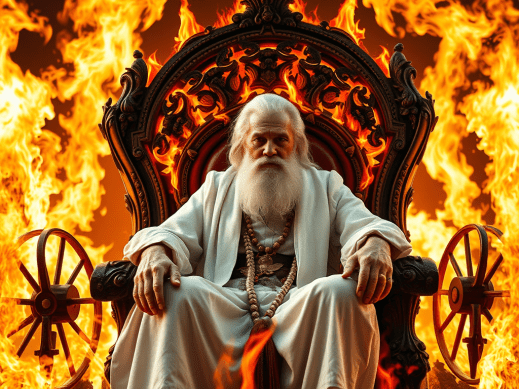
In the King James Version of the Bible, “the Lord Jesus or the Lord Jesus Christ” is mentioned 58 times. In the American Standard Version it is only mentioned 50 times. Darby, 53 times and in the Douay-Rheims, 50 times. According to the D-R & the ASV, the first usage is Mark 16:19. The KJV & Darby, Luke 24:3. According to the NA-27 Text, the D-R and the ASV are correct. “Jesus” is in the text.
What I want to look at is the word “lord.” Much to my surprise in 22 places the word is not preceded by the article “the.” This means that “lord” should not be capitalized. In every place in the Hebrew Scriptures the article “the” is connected to the word it is used with, like “the LORD God, the LORD of hosts or the Lord God.” This draws a stark contrast with the lord Jesus (Christ) and the LORD God.
For those of you who may not be aware, LORD in all capital letters is always translated Jehovah (Yahweh) = “the existing one.” It is the proper name of the One, True God. There is also the word “Lord,” in lower case letters, which is the word Adonay. Adonay is translated as lord, master or owner.
When it comes to the word Lord or lord in the Christian Scriptures it is the Greek word kurios. Here is the full meaning according to Thayer’s Greek Lexicon:
NT:2962 kurios, kuriou, ho
he to whom a person or thing belongs, about which he has the power of deciding; master, lord
a. used universally, of the possessor and disposer of a thing, the owner Matt 20:8
b. kurios is a title of honor, expressive of respect and reverence, with which servants salute their master, Matt 13:27; 25:20,22; Luke 13:8; 14:22, etc.;
c. this title is given:
a. to God, the ruler of the universe Matt 1:22
b. to the Messiah; and that:
aa. to the Messiah regarded universally: Luke 1:43
bb. to Jesus as the Messiah, Acts 10:36
d. of Christ
(from Thayer’s Greek Lexicon, Electronic Database. Copyright © 2000, 2003, 2006 by Biblesoft, Inc. All rights reserved.)
Jesus Christ is our lord, our master, our savior and even our brother. But what he is not is our king or our God. When you look up “the king Jesus,” there are no matches. Or look up the Lord Jesus God (instead of Christ or Messiah). No matches. Just look up “king,” in the N/T. You will find Jesus as the king of the Jews, the future king of Israel. You will find God called “the King eternal” in 1 Timothy 1:17. Then in Rev. 15:3 we see God called king of the holy ones. And finally in Rev. 14, which is still in the future, we see Jesus being called “Lord of lords and King of kings.”
In summary, Jesus is not the Christian’s king and never will be. He came into existence to be the Jews Messiah, and eventually their King. But, they rejected him as their Messiah and therefore his kingdom has been held in abeyance ever since. Now, his kingdom will not be set up until after the time of Jacob’s Trouble or that which is called “the Day of the LORD.” That “day” will not culminate until after the Battle of Har-Mo’ed (in Hebrew) or Har-Mageddon (in Greek). Then Jesus will set up his kingdom on earth where he will finally be King of the Jews, not king of Christians!
Dan 7:14
And there was given him dominion, and glory, and a kingdom, that all the peoples, nations, and languages should serve him: his dominion is an everlasting dominion, which shall not pass away, and his kingdom that which shall not be destroyed.
ASV
THE ASSEMBLY OF GOD
| When a friend of mine first introduced the idea of Jesus building his Church in heaven and not on the earth, and then highlighted that the church here should be called the Church of God according to the Christian Scriptures, it motivated me to look for that scripture that we all know so well, ”the Lord added to the Church daily….” Here we have it in the beloved KJV that most of us grew up on: Acts 2:47 Praising God, and having favour with all the people. And the Lord added to the church daily such as should be saved. KJV If Jesus’s Church is in Heaven, how could he be adding to it daily here on earth? (This deserves a pause for answers). Could the answer be just a matter of Translation? Let’s see what a more accurate translation says: Acts 2:47 praising God and having favor with all the people. And the Lord was adding to their number day by day those who were being saved. NASU Now that we have found a conflict between the 2 translations, what do we do? If we have a Greek Interlinear, we go look to see what it says. It says <church> 846 (Strong’s Number) auto, the same, as in all the people. So, ekklesia, 1577, which we all have been taught means church, does not exist in Acts 2:47. (The sideways carrot marks < > generally indicated that what is between them is not in the texts, as is the case here). To me this posed quite a quandary! Where do I go from here? Another formerly held belief shattered to smitherenes! So what’s left to do, look up ekklesia. Here is what it means according to Thayer’s Greek Lexicon: “a gathering of citizens called out from their homes into some public place; an assembly.” What we don’t see, is the word ”church,” as any part of the definition. What we do see, predominantly, is ”Assembly.” Now we will look at Young’s Literal Translation of a few verses containing ekklesia: Matt 16:18 ‘And I also say to thee, that thou art a rock, and upon this rock I will build my assembly, and gates of Hades shall not prevail against it; Acts 5:11 11 and great fear came upon all the assembly, and upon all who heard these things. Eph 1:22-23 22 and all things He did put under his feet, and did give him — head over all things to the assembly, 23 which is his body, the fulness of Him who is filling the all in all, Not in one verse of 114 scriptures where ekklesia is used, does the YLT translate it Church! You might be asking yourself, ”If ekklesia doesn’t mean Church, then what the heck, if anything, does?” Good question. Etymology of the word Church The etymology of the word “church” is a complex and multifaceted topic. Based on the provided search results, here is a summary of the key findings: Greek origins: The English word “church” is ultimately derived from the Greek adjective “kuriakos” (κυριακός), meaning “of (or belonging to) the Lord”. This adjective is found only twice in the New Testament, in 1 Corinthians 11:20 and Revelation 1:10, referring to the Lord’s supper and the Lord’s day, respectively. |
| 1 Cor 11:20 Therefore when you meet together, it is not to eat the Lord’s Supper, The Lord’s is the word NT:2960 kuriakos (koo-ree-ak-os’); from NT:2962, kurios; belonging to the Lord (Jehovah or Jesus): (Biblesoft’s New Exhaustive Strong’s Numbers and Concordance with Expanded Greek-Hebrew Dictionary. Copyright © 1994, 2003, 2006 Biblesoft, Inc. and International Bible Translators, Inc.) Rev 1:10-11 I was in the spirit on the Lord’s day, and I heard behind me a loud voice like the sound of a trumpet, NASU Much like we have eliminated Old Testament and New Testament from our vocabulary, I think it is time to eliminate “Church” as well! If as close as we can come to it, is a transliteration of kuriakos, we have a pretty weak case for using it at all. |
Transliteration vs. Translation:
The word “church” is a transliteration of the Greek “kuriakos,” rather than a translation of its meaning into English. This means that the word “church” does not accurately convey the original Greek concept.
Substitution for ekklēsia: In English translations of the New Testament, the word “church” substitutes for the Greek noun “ekklēsia” (ἐκκλησία), which occurs 114 times in the Greek New Testament. This substitution obscures the original meaning of “ekklēsia”, which refers to the gathering or assembly of believers.
Alternative etymologies:
Some sources propose alternative etymologies for the word “church”, including:
Connection to the name “Circe”, a sorceress-goddess from Greek mythology, which is unlikely and lacks historical evidence.
Derivation from the Old English “circe” or “cyrc”, which is related to the Dutch “kerk” and German “Kirche”, ultimately tracing back to the Greek phrase “kuriakon doma” (Lord’s house).
Architectural significance: The term “church” has also been associated with the architectural design of Christian buildings, particularly in traditional Christian architecture, where the plan view forms a Christian cross.”
I am of the opinion that what exists in the Hebrew Scriptures should set the precedence for the Christian Scriptures. For example, Church doesn’t exist in the Hebrew Scriptures any more than resurrection does. But what does exist is qahal — OT:6951 an assembly, a company, a congregation, a convocation
a) an assembly for evil counsel, for war or invasion, for religious purposes Ex. 12:6
b) a company (used of returning exiles) Ez. 38:15
c) a congregation as an organized body Joel 2:16
(from The Online Bible Thayer’s Greek Lexicon and Brown Driver & Briggs Hebrew Lexicon, Copyright © 1993, Woodside Bible Fellowship, Ontario, Canada. Licensed from the Institute for Creation Research.)
Deut 31:30 Then Moses spoke in the hearing of all the assembly of Israel the words of this song, until they were complete: NASU
Judg 20:2 And the chief of all the people, even of all the tribes of Israel, presented themselves in the assembly of the people of God, four hundred thousand footmen that drew sword. KJV
Qahal is used 123 times in the Hebrew Scriptures, coming close to the 114 of ekklesia!
Other usages of Assembly in the Hebrew Scriptures:
5712, edah, 149 times
6116, atsarah, 11 times
5475, cowd, 21 times Job 15:8, 29:4 the secret of God; Ps. 89:7 the assembly of the saints!
4186, mowshab, 44 times
4150, mowed/moed, 223 times Is. 41:13 Mount of Assembly
1 Cor 10:31-32
Whether, then, ye eat, or drink, or do anything, do all to the glory of God;
32 become offenceless, both to Jews and Greeks, and to the assembly of God;
YLT
I know it’s going to be difficultfor us to stop using the word Church when it comes to a group of believer’s, but you can still call the buildings, churches. Otherwise, the Body of Christ is the Assembly of God.
Some Differences between being Born Again and Being Saved
In order to understand what being “born again” means we must first look at the context in which it is used.
John 3:1-8
Nicodemus was a Pharisee and a member of the Jewish council.
2 He came to Jesus one night and said to him, “Rabbi, we know that God has sent you as a teacher. No one can perform the miracles you perform unless God is with him.”
3 Jesus replied to Nicodemus, “I can guarantee this truth: No one can see the kingdom of God without being born from above (anoothen).” This is normally translated born again.
4 Nicodemus asked him, “How can anyone be born when he’s an old man? He can’t go back inside his mother a second time to be born, can he?”
5 Jesus answered Nicodemus, “I can guarantee this truth: No one can enter the kingdom of God without being born of water and the spirit (pneuma).
6 Flesh and blood give birth to flesh and blood, but the Spirit (pneuma) gives birth to things that are spiritual (pneuma).
7 Don’t be surprised when I tell you that all of you must be born from above (anoothen).
8 The wind (pneuma) blows wherever it pleases. You hear its sound, but you don’t know where it comes from or where it’s going. That’s the way it is with everyone born of the spirit (pneuma).”
(from GOD’S WORD Copyright © 1995 by God’s Word to the Nations Bible Society. All rights reserved.)
The next usage of anothen is in verse 31:
John 3:31-34
He that cometh from above is above all: he that is of the earth is earthly, and speaketh of the earth: he that cometh from heaven is above all.
32 And what he hath seen and heard, that he testifieth; and no man receiveth his testimony.
33 He that hath received his testimony hath set to his seal that God is true.
34 For he whom God hath sent speaketh the words of God: for God giveth not the spirit by measure unto him. KJV
What was it that Jesus expected Nicodemus to know? For starters, Ezek 11:19:
“And I will give them one heart, and I will put a new spirit within you; and I will take the stony heart out of their flesh, and will give them an heart of flesh:” KJV
Also, Ezek 36:26-27: “A new heart also will I give you, and a new spirit will I put within you: and I will take away the stony heart out of your flesh, and I will give you an heart of flesh. 27 And I will put my spirit within you, and cause you to walk in my statutes, and ye shall keep my judgments, and do them.” KJV
Finally, Jer 31:33-34: “But this shall be the covenant that I will make with the house of Israel; After those days, saith the Lord, I will put my law in their inward parts, and write it in their hearts; and will be their God, and they shall be my people.
34 And they shall teach no more every man his neighbour, and every man his brother, saying, Know the Lord: for they shall all know me, from the least of them unto the greatest of them, saith the Lord; for I will forgive their iniquity, and I will remember their sin no more.” KJV
This is what Jesus knew and expected Nicodemus to know as well. Jesus expected “those days” that Jeremiah spoke about, to begin immediately after his ascension and culminate with the Battle of Armageddon, when the Kingdom of God would begin. His mindset was a relatively short period of time.
Now, let’s take a look at anagennao, to produce again, to beget again, to beget anew. Its first usage is in 1 Peter 1:3-5:
“Blessed be the God and Father of our Lord Jesus Christ, who according to His abundant mercy has begotten us again to a living hope through the resurrection of Jesus Christ from the dead, 4 to an inheritance incorruptible and undefiled and that does not fade away, reserved in heaven for you, 5 who are kept by the power of God through faith for salvation ready to be revealed in the last time.”
NKJV
The second and final usage 1 Peter 1:22-23: “Since you have purified your souls in obeying the truth through the spirit in sincere love of the brethren, love one another fervently with a pure heart, 23 having been born again, not of corruptible seed but incorruptible, through the word of God which lives and abides forever, NKJV
In contrasting the usages of these Greek words we can immediately see that there is no mention of “seed” or any “begetting” in John. Not only that, but we also see with that seed is an incorruptible, undefiled inheritance that does njot fade away with time! It is also interesting that 1:5 mentions “the last time,” perhaps a parallel of “after those days.”
In summary we know Jesus was talking to “a master (teacher) of Israel” and that he, Jesus, was referring to some Hebrew Scriptures when he spoke of being born from above and seeing and entering the kingdom of God. For the Jews, it was going to be impossible for them to enter into the kingdom without God making it happen. Ezekiel and Jeremiah show us that God was going to put his spirit in them and they are, in the future, going to walk in his ways.
On the other hand, both Jew and Gentile can be begotten again now, enjoy the current benefits of salvation, reap the rewards of our godly works in heaven and then enjoy the full benefits of salvation after those days of the tribulation. I would say there is a vast difference between what Jesus and Peter were speaking of. And these are just the ones on the surface!
The Elusive Kingdom of God
I used to think saying the Lord’s Prayer was ludicrous until I realized that we were still praying for God’s kingdom to come. Jesus taught his Jewish followers to pray for God’s kingdom to come and Christians today are still doing the same. Why? Because it has not yet come. Let’s see what scriptures teach us about it.
Acts 1:1-6
The former treatise have I made, O Theophilus, of all that Jesus began both to do and teach,
2 Until the day in which he was taken up, after that he through (no article the) holy spirit had given commandments unto the apostles whom he had chosen: To whom also he shewed himself alive after his passion by many infallible proofs, being seen of them forty days, and speaking of the things pertaining to the kingdom of God: And, being assembled together with them, commanded them that they should not depart from Jerusalem, but wait for the promise of the Father, which, saith he, ye have heard of me. For John truly baptized with water; but ye shall be baptized with (no article the) holy spirit not many days hence. When they therefore were come together, they asked of him, saying, Lord, wilt thou at this time restore again the kingdom to Israel?
Until the day Jesus ascended into Heaven his followers wondered when the kingdom was going to be restored to Israel. Obviously it had not been up to that time.
In Acts 14, it is implied that the Kingdom of God is something to be “entered into:” Acts 14:22
Confirming the souls of the disciples, and exhorting them to continue in the faith, and that we must through much tribulation enter into the kingdom of God. KJV
It’s the word eiserchomai, to come or go into. Here it says much tribulation is required to go into the kingdom. In the following verses the kingdom of God is something to be “inherited:” 1 Cor 6:9-10:
9 Know ye not that the unrighteous shall not inherit the kingdom of God? Be not deceived: neither fornicators, nor idolaters, nor adulterers, nor effeminate, nor abusers of themselves with mankind, nor thieves, nor covetous, nor drunkards, nor revilers, nor extortioners, shall inherit the kingdom of God. KJV
1 Cor 15:50 confirms the previous scriptures:
Now this I say, brethren, that flesh and blood cannot inherit the kingdom of God; neither doth corruption inherit incorruption. KJV
Another verse implying that the kingdom is something to be inherited: Gal 5:19-21
Now the works of the flesh are manifest, which are these; Adultery, fornication, uncleanness, lasciviousness, Idolatry, witchcraft, hatred, variance, emulations, wrath, strife, seditions, heresies, Envyings, murders, drunkenness, revellings, and such like: of the which I tell you before, as I have also told you in time past, that they which do such things shall not inherit the kingdom of God.
Here is the next to last usage of the koG: Col 4:11:
And Jesus, which is called Justus, who are of the circumcision. These only are my fellow-workers unto the kingdom of God, which have been a comfort unto me. KJV
“Unto” the kingdom is the same word as “into” in the verses in 1 Cor. 6, come “into,” eis.
I think it is very clear from scripture that the kingdom of God is not something we are in, but something that is still in the future. Jesus came to bring it to Israel, but the promises to Israel are being held in abeyance. We too will share in that promise, in the Millennial Kingdom, after the Rapture of the Church.


