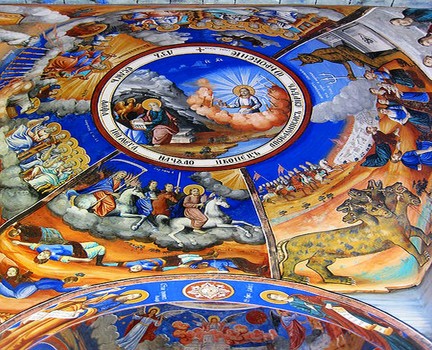
The Most High God, On His Throne, Acc. to Daniel 7

In the King James Version of the Bible, “the Lord Jesus or the Lord Jesus Christ” is mentioned 58 times. In the American Standard Version it is only mentioned 50 times. Darby, 53 times and in the Douay-Rheims, 50 times. According to the D-R & the ASV, the first usage is Mark 16:19. The KJV & Darby, Luke 24:3. According to the NA-27 Text, the D-R and the ASV are correct. “Jesus” is in the text.
What I want to look at is the word “lord.” Much to my surprise in 22 places the word is not preceded by the article “the.” This means that “lord” should not be capitalized. In every place in the Hebrew Scriptures the article “the” is connected to the word it is used with, like “the LORD God, the LORD of hosts or the Lord God.” This draws a stark contrast with the lord Jesus (Christ) and the LORD God.
For those of you who may not be aware, LORD in all capital letters is always translated Jehovah (Yahweh) = “the existing one.” It is the proper name of the One, True God. There is also the word “Lord,” in lower case letters, which is the word Adonay. Adonay is translated as lord, master or owner.
When it comes to the word Lord or lord in the Christian Scriptures it is the Greek word kurios. Here is the full meaning according to Thayer’s Greek Lexicon:
NT:2962 kurios, kuriou, ho
he to whom a person or thing belongs, about which he has the power of deciding; master, lord
a. used universally, of the possessor and disposer of a thing, the owner Matt 20:8
b. kurios is a title of honor, expressive of respect and reverence, with which servants salute their master, Matt 13:27; 25:20,22; Luke 13:8; 14:22, etc.;
c. this title is given:
a. to God, the ruler of the universe Matt 1:22
b. to the Messiah; and that:
aa. to the Messiah regarded universally: Luke 1:43
bb. to Jesus as the Messiah, Acts 10:36
d. of Christ
(from Thayer’s Greek Lexicon, Electronic Database. Copyright © 2000, 2003, 2006 by Biblesoft, Inc. All rights reserved.)
Jesus Christ is our lord, our master, our savior and even our brother. But what he is not is our king or our God. When you look up “the king Jesus,” there are no matches. Or look up the Lord Jesus God (instead of Christ or Messiah). No matches. Just look up “king,” in the N/T. You will find Jesus as the king of the Jews, the future king of Israel. You will find God called “the King eternal” in 1 Timothy 1:17. Then in Rev. 15:3 we see God called king of the holy ones. And finally in Rev. 14, which is still in the future, we see Jesus being called “Lord of lords and King of kings.”
In summary, Jesus is not the Christian’s king and never will be. He came into existence to be the Jews Messiah, and eventually their King. But, they rejected him as their Messiah and therefore his kingdom has been held in abeyance ever since. Now, his kingdom will not be set up until after the time of Jacob’s Trouble or that which is called “the Day of the LORD.” That “day” will not culminate until after the Battle of Har-Mo’ed (in Hebrew) or Har-Mageddon (in Greek). Then Jesus will set up his kingdom on earth where he will finally be King of the Jews, not king of Christians!
Dan 7:14
And there was given him dominion, and glory, and a kingdom, that all the peoples, nations, and languages should serve him: his dominion is an everlasting dominion, which shall not pass away, and his kingdom that which shall not be destroyed.
ASV
THE ASSEMBLY OF GOD
| When a friend of mine first introduced the idea of Jesus building his Church in heaven and not on the earth, and then highlighted that the church here should be called the Church of God according to the Christian Scriptures, it motivated me to look for that scripture that we all know so well, ”the Lord added to the Church daily….” Here we have it in the beloved KJV that most of us grew up on: Acts 2:47 Praising God, and having favour with all the people. And the Lord added to the church daily such as should be saved. KJV If Jesus’s Church is in Heaven, how could he be adding to it daily here on earth? (This deserves a pause for answers). Could the answer be just a matter of Translation? Let’s see what a more accurate translation says: Acts 2:47 praising God and having favor with all the people. And the Lord was adding to their number day by day those who were being saved. NASU Now that we have found a conflict between the 2 translations, what do we do? If we have a Greek Interlinear, we go look to see what it says. It says <church> 846 (Strong’s Number) auto, the same, as in all the people. So, ekklesia, 1577, which we all have been taught means church, does not exist in Acts 2:47. (The sideways carrot marks < > generally indicated that what is between them is not in the texts, as is the case here). To me this posed quite a quandary! Where do I go from here? Another formerly held belief shattered to smitherenes! So what’s left to do, look up ekklesia. Here is what it means according to Thayer’s Greek Lexicon: “a gathering of citizens called out from their homes into some public place; an assembly.” What we don’t see, is the word ”church,” as any part of the definition. What we do see, predominantly, is ”Assembly.” Now we will look at Young’s Literal Translation of a few verses containing ekklesia: Matt 16:18 ‘And I also say to thee, that thou art a rock, and upon this rock I will build my assembly, and gates of Hades shall not prevail against it; Acts 5:11 11 and great fear came upon all the assembly, and upon all who heard these things. Eph 1:22-23 22 and all things He did put under his feet, and did give him — head over all things to the assembly, 23 which is his body, the fulness of Him who is filling the all in all, Not in one verse of 114 scriptures where ekklesia is used, does the YLT translate it Church! You might be asking yourself, ”If ekklesia doesn’t mean Church, then what the heck, if anything, does?” Good question. Etymology of the word Church The etymology of the word “church” is a complex and multifaceted topic. Based on the provided search results, here is a summary of the key findings: Greek origins: The English word “church” is ultimately derived from the Greek adjective “kuriakos” (κυριακός), meaning “of (or belonging to) the Lord”. This adjective is found only twice in the New Testament, in 1 Corinthians 11:20 and Revelation 1:10, referring to the Lord’s supper and the Lord’s day, respectively. |
| 1 Cor 11:20 Therefore when you meet together, it is not to eat the Lord’s Supper, The Lord’s is the word NT:2960 kuriakos (koo-ree-ak-os’); from NT:2962, kurios; belonging to the Lord (Jehovah or Jesus): (Biblesoft’s New Exhaustive Strong’s Numbers and Concordance with Expanded Greek-Hebrew Dictionary. Copyright © 1994, 2003, 2006 Biblesoft, Inc. and International Bible Translators, Inc.) Rev 1:10-11 I was in the spirit on the Lord’s day, and I heard behind me a loud voice like the sound of a trumpet, NASU Much like we have eliminated Old Testament and New Testament from our vocabulary, I think it is time to eliminate “Church” as well! If as close as we can come to it, is a transliteration of kuriakos, we have a pretty weak case for using it at all. |
Transliteration vs. Translation:
The word “church” is a transliteration of the Greek “kuriakos,” rather than a translation of its meaning into English. This means that the word “church” does not accurately convey the original Greek concept.
Substitution for ekklēsia: In English translations of the New Testament, the word “church” substitutes for the Greek noun “ekklēsia” (ἐκκλησία), which occurs 114 times in the Greek New Testament. This substitution obscures the original meaning of “ekklēsia”, which refers to the gathering or assembly of believers.
Alternative etymologies:
Some sources propose alternative etymologies for the word “church”, including:
Connection to the name “Circe”, a sorceress-goddess from Greek mythology, which is unlikely and lacks historical evidence.
Derivation from the Old English “circe” or “cyrc”, which is related to the Dutch “kerk” and German “Kirche”, ultimately tracing back to the Greek phrase “kuriakon doma” (Lord’s house).
Architectural significance: The term “church” has also been associated with the architectural design of Christian buildings, particularly in traditional Christian architecture, where the plan view forms a Christian cross.”
I am of the opinion that what exists in the Hebrew Scriptures should set the precedence for the Christian Scriptures. For example, Church doesn’t exist in the Hebrew Scriptures any more than resurrection does. But what does exist is qahal — OT:6951 an assembly, a company, a congregation, a convocation
a) an assembly for evil counsel, for war or invasion, for religious purposes Ex. 12:6
b) a company (used of returning exiles) Ez. 38:15
c) a congregation as an organized body Joel 2:16
(from The Online Bible Thayer’s Greek Lexicon and Brown Driver & Briggs Hebrew Lexicon, Copyright © 1993, Woodside Bible Fellowship, Ontario, Canada. Licensed from the Institute for Creation Research.)
Deut 31:30 Then Moses spoke in the hearing of all the assembly of Israel the words of this song, until they were complete: NASU
Judg 20:2 And the chief of all the people, even of all the tribes of Israel, presented themselves in the assembly of the people of God, four hundred thousand footmen that drew sword. KJV
Qahal is used 123 times in the Hebrew Scriptures, coming close to the 114 of ekklesia!
Other usages of Assembly in the Hebrew Scriptures:
5712, edah, 149 times
6116, atsarah, 11 times
5475, cowd, 21 times Job 15:8, 29:4 the secret of God; Ps. 89:7 the assembly of the saints!
4186, mowshab, 44 times
4150, mowed/moed, 223 times Is. 41:13 Mount of Assembly
1 Cor 10:31-32
Whether, then, ye eat, or drink, or do anything, do all to the glory of God;
32 become offenceless, both to Jews and Greeks, and to the assembly of God;
YLT
I know it’s going to be difficultfor us to stop using the word Church when it comes to a group of believer’s, but you can still call the buildings, churches. Otherwise, the Body of Christ is the Assembly of God.
Some Differences between being Born Again and Being Saved
In order to understand what being “born again” means we must first look at the context in which it is used.
John 3:1-8
Nicodemus was a Pharisee and a member of the Jewish council.
2 He came to Jesus one night and said to him, “Rabbi, we know that God has sent you as a teacher. No one can perform the miracles you perform unless God is with him.”
3 Jesus replied to Nicodemus, “I can guarantee this truth: No one can see the kingdom of God without being born from above (anoothen).” This is normally translated born again.
4 Nicodemus asked him, “How can anyone be born when he’s an old man? He can’t go back inside his mother a second time to be born, can he?”
5 Jesus answered Nicodemus, “I can guarantee this truth: No one can enter the kingdom of God without being born of water and the spirit (pneuma).
6 Flesh and blood give birth to flesh and blood, but the Spirit (pneuma) gives birth to things that are spiritual (pneuma).
7 Don’t be surprised when I tell you that all of you must be born from above (anoothen).
8 The wind (pneuma) blows wherever it pleases. You hear its sound, but you don’t know where it comes from or where it’s going. That’s the way it is with everyone born of the spirit (pneuma).”
(from GOD’S WORD Copyright © 1995 by God’s Word to the Nations Bible Society. All rights reserved.)
The next usage of anothen is in verse 31:
John 3:31-34
He that cometh from above is above all: he that is of the earth is earthly, and speaketh of the earth: he that cometh from heaven is above all.
32 And what he hath seen and heard, that he testifieth; and no man receiveth his testimony.
33 He that hath received his testimony hath set to his seal that God is true.
34 For he whom God hath sent speaketh the words of God: for God giveth not the spirit by measure unto him. KJV
What was it that Jesus expected Nicodemus to know? For starters, Ezek 11:19:
“And I will give them one heart, and I will put a new spirit within you; and I will take the stony heart out of their flesh, and will give them an heart of flesh:” KJV
Also, Ezek 36:26-27: “A new heart also will I give you, and a new spirit will I put within you: and I will take away the stony heart out of your flesh, and I will give you an heart of flesh. 27 And I will put my spirit within you, and cause you to walk in my statutes, and ye shall keep my judgments, and do them.” KJV
Finally, Jer 31:33-34: “But this shall be the covenant that I will make with the house of Israel; After those days, saith the Lord, I will put my law in their inward parts, and write it in their hearts; and will be their God, and they shall be my people.
34 And they shall teach no more every man his neighbour, and every man his brother, saying, Know the Lord: for they shall all know me, from the least of them unto the greatest of them, saith the Lord; for I will forgive their iniquity, and I will remember their sin no more.” KJV
This is what Jesus knew and expected Nicodemus to know as well. Jesus expected “those days” that Jeremiah spoke about, to begin immediately after his ascension and culminate with the Battle of Armageddon, when the Kingdom of God would begin. His mindset was a relatively short period of time.
Now, let’s take a look at anagennao, to produce again, to beget again, to beget anew. Its first usage is in 1 Peter 1:3-5:
“Blessed be the God and Father of our Lord Jesus Christ, who according to His abundant mercy has begotten us again to a living hope through the resurrection of Jesus Christ from the dead, 4 to an inheritance incorruptible and undefiled and that does not fade away, reserved in heaven for you, 5 who are kept by the power of God through faith for salvation ready to be revealed in the last time.”
NKJV
The second and final usage 1 Peter 1:22-23: “Since you have purified your souls in obeying the truth through the spirit in sincere love of the brethren, love one another fervently with a pure heart, 23 having been born again, not of corruptible seed but incorruptible, through the word of God which lives and abides forever, NKJV
In contrasting the usages of these Greek words we can immediately see that there is no mention of “seed” or any “begetting” in John. Not only that, but we also see with that seed is an incorruptible, undefiled inheritance that does njot fade away with time! It is also interesting that 1:5 mentions “the last time,” perhaps a parallel of “after those days.”
In summary we know Jesus was talking to “a master (teacher) of Israel” and that he, Jesus, was referring to some Hebrew Scriptures when he spoke of being born from above and seeing and entering the kingdom of God. For the Jews, it was going to be impossible for them to enter into the kingdom without God making it happen. Ezekiel and Jeremiah show us that God was going to put his spirit in them and they are, in the future, going to walk in his ways.
On the other hand, both Jew and Gentile can be begotten again now, enjoy the current benefits of salvation, reap the rewards of our godly works in heaven and then enjoy the full benefits of salvation after those days of the tribulation. I would say there is a vast difference between what Jesus and Peter were speaking of. And these are just the ones on the surface!
The Elusive Kingdom of God
I used to think saying the Lord’s Prayer was ludicrous until I realized that we were still praying for God’s kingdom to come. Jesus taught his Jewish followers to pray for God’s kingdom to come and Christians today are still doing the same. Why? Because it has not yet come. Let’s see what scriptures teach us about it.
Acts 1:1-6
The former treatise have I made, O Theophilus, of all that Jesus began both to do and teach,
2 Until the day in which he was taken up, after that he through (no article the) holy spirit had given commandments unto the apostles whom he had chosen: To whom also he shewed himself alive after his passion by many infallible proofs, being seen of them forty days, and speaking of the things pertaining to the kingdom of God: And, being assembled together with them, commanded them that they should not depart from Jerusalem, but wait for the promise of the Father, which, saith he, ye have heard of me. For John truly baptized with water; but ye shall be baptized with (no article the) holy spirit not many days hence. When they therefore were come together, they asked of him, saying, Lord, wilt thou at this time restore again the kingdom to Israel?
Until the day Jesus ascended into Heaven his followers wondered when the kingdom was going to be restored to Israel. Obviously it had not been up to that time.
In Acts 14, it is implied that the Kingdom of God is something to be “entered into:” Acts 14:22
Confirming the souls of the disciples, and exhorting them to continue in the faith, and that we must through much tribulation enter into the kingdom of God. KJV
It’s the word eiserchomai, to come or go into. Here it says much tribulation is required to go into the kingdom. In the following verses the kingdom of God is something to be “inherited:” 1 Cor 6:9-10:
9 Know ye not that the unrighteous shall not inherit the kingdom of God? Be not deceived: neither fornicators, nor idolaters, nor adulterers, nor effeminate, nor abusers of themselves with mankind, nor thieves, nor covetous, nor drunkards, nor revilers, nor extortioners, shall inherit the kingdom of God. KJV
1 Cor 15:50 confirms the previous scriptures:
Now this I say, brethren, that flesh and blood cannot inherit the kingdom of God; neither doth corruption inherit incorruption. KJV
Another verse implying that the kingdom is something to be inherited: Gal 5:19-21
Now the works of the flesh are manifest, which are these; Adultery, fornication, uncleanness, lasciviousness, Idolatry, witchcraft, hatred, variance, emulations, wrath, strife, seditions, heresies, Envyings, murders, drunkenness, revellings, and such like: of the which I tell you before, as I have also told you in time past, that they which do such things shall not inherit the kingdom of God.
Here is the next to last usage of the koG: Col 4:11:
And Jesus, which is called Justus, who are of the circumcision. These only are my fellow-workers unto the kingdom of God, which have been a comfort unto me. KJV
“Unto” the kingdom is the same word as “into” in the verses in 1 Cor. 6, come “into,” eis.
I think it is very clear from scripture that the kingdom of God is not something we are in, but something that is still in the future. Jesus came to bring it to Israel, but the promises to Israel are being held in abeyance. We too will share in that promise, in the Millennial Kingdom, after the Rapture of the Church.
People are Souls, They have a Heart, but are Soul-less

Most of us have likely heard the expression “Bob is an old soul or Sandy is a young soul,” right? We don’t hear people say “John ‘has’ a young soul.” We do hear them say that so and so is young at heart, though.
In the Hebrew Scriptures Strong’s defines Nephesh as a breathing creature, i.e. animal of vitality; Brown-Driver-Briggs Hebrew Lexicon as a soul, self, life, a creature, a person, an appetite, a mind, a living being, a desire, an emotion, a passion. As you can see from the definition whatever it is, it is alive and vital.
For the sake of this teaching I am going to be using the Darby Bible since it uses the words “living soul” twelve times. The first usage is:
Gen 1:21 “And God created the great sea monsters, and every living soul that moves with which the waters swarm, after their kind, and every winged fowl after its kind. And God saw that it was good.” Most other popular versions use the word “creature or “thing” instead of soul.
What does every living soul do? They move! Whether they creep, crawl, swim or fly, they are living souls. I never really thought about worms, ants, bees or snails as being living souls, but I guess they are!
The second usage (and so on):
Gen 1:30 “and to every animal of the earth, and to every fowl of the heavens, and to everything that creepeth on the earth, which is a living soul, every green herb for food. And it was so”
Gen 2:7 “And Jehovah Elohim formed Man, dust of the ground, and breathed into his nostrils the breath of life; and Man became a living soul.”
Gen 2:19 “And out of the ground Jehovah Elohim had formed every animal of the field and all fowl of the heavens, and brought [them] to Man, to see what he would call them; and whatever Man called each living soul, that was its name.”
Gen 9:10 “and with every living soul which is with you, fowl as well as cattle, and all the animals of the earth with you, of all that has gone out of the ark — every animal of the earth.”
Gen 9:12 “And God said, This is the sign of the covenant that I set between me and you and every living soul that is with you, for everlasting generations:’
Gen 9:15-16 “and I will remember my covenant which is between me and you and every living soul of all flesh; and the waters shall not henceforth become a flood to destroy all flesh. And the bow shall be in the cloud; and I will look upon it, that I may remember the everlasting covenant between God and every living soul of all flesh that is upon the earth.
Lev 11:10 “but all that have not fins and scales in seas and in rivers, of all that swarm in the waters, and of every living soul which is in the waters — they shall be an abomination unto you.”
Lev 11:46 “This is the law of cattle, and of fowl, and of every living soul that moveth in the waters, and of every soul (creature) that crawleth on the earth;”
1 Cor 15:45 “Thus also it is written, The first man Adam became a living soul; the last Adam a quickening spirit.”
Rev 16:3 “And the second poured out his bowl on the sea; and it became blood, as of a dead man; and every living soul died in the sea.”
The following verses are from a Bible called The Message. Some of you OG’s may remember seeing it but it is one of the seventeen Bibles in my PC Bible Program.
1 Kings 15:29 “As soon as he was king he killed everyone in Jeroboam’s family. There wasn’t a living soul left to the name of Jeroboam; Baasha wiped them out totally,”
2 Chron 20:24 “As Judah came up over the rise, looking into the wilderness for the horde of barbarians, they looked on a killing field of dead bodies — not a living soul among them.”
Job 12:10 “Every living soul, yes, every breathing creature?”
Acts 3:22-23 “Moses, for instance, said, ‘Your God will raise up for you a prophet just like me from your family. Listen to every word he speaks to you. Every last living soul who refuses to listen to that prophet will be wiped out from the people.’ “
At the risk of becoming exhaustive I am compelled to give you every usage I could find on the 2 words. These verse are from the good old Catholic Bible, The Douay-Rheims. The first one we have already covered but I had to include it because someone mentioned something about adding water to dust to from the body of man. The Monks already took care of that!
Gen 2:7 “And the Lord God formed man of the slime of the earth: and breathed into his face the breath of life, and man became a living soul.
Gen 8:21 “And the Lord smelled a sweet savour, and said: I will no more curse the earth for the sake of man: for the imagination and thought of man’s heart are prone to evil from his youth: therefore I will no more destroy every living soul as I have done.”
Now for some of you younger souls, there are 400 more usages of soul in the Hebrew Scriptures. Feel free to have at ‘em. I’m just going to show a few that pop out at me.
Lev 5:1-4 “And if a soul sin, and hear the voice of swearing, and is a witness, whether he hath seen or known of it; if he do not utter it, then he shall bear his iniquity. 2 Or if a soul touch any unclean thing…………3 Or if he touch the uncleanness of man…………4 Or if a soul swear, pronouncing with his lips to do evil, or to do good, whatsoever it be that a man shall pronounce with an oath, and it be hid from him; when he knoweth of it, then he shall be guilty in one of these. KJV
Deut 12:20-21 “When the Lord thy God shall enlarge thy border, as he hath promised thee, and thou shalt say, I will eat flesh, because thy soul longeth to eat flesh; thou mayest eat flesh, whatsoever thy soul lusteth after. 21 ………whatsoever thy soul lusteth after. KJV
To be honest and fair, there are many verses that would incline one to believe that the soul is something distinctly independent of the person. Here is just one:
Isa 29:8 “It shall even be as when an hungry man dreameth, and, behold, he eateth; but he awaketh, and his soul is empty: or as when a thirsty man dreameth, and, behold, he drinketh; but he awaketh, and, behold, he is faint, and his soul hath appetite: so shall the multitude of all the nations be, that fight against mount Zion. KJV
Here is what one Commentary says about it: “[It shall even be …] This is a most striking figure representing the earnest desire of the Assyrian to possess the city of Jerusalem, and his utter disappointment.
(from Barnes’ Notes, Electronic Database Copyright © 1997, 2003, 2005, 2006 by Biblesoft, Inc. All rights reserved.)
Who would have thought that?
BTW, I looked up dead soul and couldn’t find anything. But, nothing is more convincing than looking at the 78 times soul(s) plural was used in the KJV! Then you will become further convinced that souls are living “things” that take breath, including fish, worms and bugs! You could even say, “If it shits, it’s a living soul!”
Souls Plural
Gen 46:15 These be the sons of Leah, which she bare unto Jacob in Padan-aram, with his daughter Dinah: all the souls of his sons and his daughters were thirty and three. KJV
Gen 46:18 These are the sons of Zilpah, whom Laban gave to Leah his daughter, and these she bare unto Jacob, even sixteen souls. KJV
Gen 46:22 These are the sons of Rachel, which were born to Jacob: all the souls were fourteen.
Gen 46:25 These are the sons of Bilhah, which Laban gave unto Rachel his daughter, and she bare these unto Jacob: all the souls were seven.
26 All the souls that came with Jacob into Egypt, which came out of his loins, besides Jacob’s sons’ wives, all the souls were threescore and six;
27 And the sons of Joseph, which were born him in Egypt, were two souls: all the souls of the house of Jacob, which came into Egypt, were threescore and ten.
Acts 7:14 Then sent Joseph, and called his father Jacob to him, and all his kindred, threescore and fifteen souls. KJV
Acts 27:37 And we were in all in the ship two hundred threescore and sixteen souls. KJV
1 Peter 3:20 Which sometime were disobedient, when once the longsuffering of God waited in the days of Noah, while the ark was a preparing, wherein few, that is, eight souls were saved by water. KJV
Acts 2:41 Then they that gladly received his word were baptized: and the same day there were added unto them about three thousand souls.
Acts 7:14 Then sent Joseph, and called his father Jacob to him, and all his kindred, threescore and fifteen souls.
Since Bob mentioned the Apocraphal and extra Canonical Books I thought it would be cool to look at a few of those as well.
Judith 7:26-27 Now therefore call them unto you, and deliver the whole city for a spoil to the people of Holofernes, and to all his army. For it is better for us to be made a spoil unto them, than to die for thirst: for we will be his servants, that our souls may live, and not see the death of our infants before our eyes, nor our wives nor our children to die. KJV
Judith seems to be a pretty smart lady. I’ve always said that no one is any good to God dead! Here she would rather be someone’s spoil than starve to death!
Wisdom 2:22-3:1 As for the mysteries of God, they knew them not: neither hoped they for the wages of righteousness, nor discerned a reward for blameless souls. For God created man to be immortal, and made him to be an image of his own eternity. Nevertheless through envy of the devil came death into the world: and they that do hold of his side do find it. But the souls of the righteous are in the hand of God, and there shall no torment touch them. KJV
Being a soul as opposed to having one eliminates a whole bunch of things which we know are not true, like soul sleep, transmigration of the soul, or soul travel.
Part IV of the Apocalupsis of John, the Book called Revelation
In the preceding 3 posts I have established beyond any doubt that the miscalled “churches” in The Apocalupsis of John are in reality assemblies or congregations of Jews, members of the Nation of Israel. To give you an example of how unsound some believers can be, a woman, whose blog I used to follow, said to me, “If Jesus called them churches, then that’s what they are!” Unfortunately Jesus has had nothing to do with how translators have chosen to translate most of the words in the Bible. Out of 17 Bible versions or translations in my PC Bible program only these 3 translate ecclesia properly:
Rev 1:4
John to the seven assemblies that [are] in Asia:
YLT- Young’s Literal Translation
Rev 1:4
4 John to the seven assemblies
Darby
Rev 1:4
4 John, to the seven assemblies that are in Asia:
WEB- World English Bible
If you are a serious workman of the Word or want to be you must invest in some PC Bible program or buy a lot of Bibles! On my way home from NY last Sunday by way of Chicago I had the opportunity to sit next to a young Jewish girl who had recently become a Christian. She was very well versed in the “mainstream” doctrines of Christianity. She was surprised to hear many things I had to say about beliefs she held and took a copious amount of notes on her phone. I was able to show her from the Scriptures (on her phone) passages which substantiated what I had to say, but she could not find one Scripture to substantiate anything she believed! Everything she believed hear-say and much of that was heresy!
She was even astonished to see from 1 Corinthians 10:32 that the apostle Paul established that there are only 3 types of people in the world; Jews, Gentiles and the Church of God. She was equally surprised to see these verses:
Gal 3:28-29
There is neither Jew nor Greek, there is neither bond nor free, there is neither male nor female: for ye are all one in Christ Jesus.
29 And if ye be Christ’s, then are ye Abraham’s seed, and heirs according to the promise.
KJV
She was insisting that she was a Jew for Jesus. What an absurd belief. I tried to explain to her that once a Jew or a Gentile became born again of the spirit of God by confessing Jesus as their Lord and believing God raised him from the dead, they became members of the Church of God. She could not let go of her ancestry and she could not understand how I could be of the seed of Abraham. She really imploded when I told her that Abraham was a Gentile and not a Jew!
Abram is first mentioned in Ge. 11:26; his name was changed to Abraham in Ge. 17:5. Jacob isn’t mentioned until Ge. 25:26 and his name was not changed to Israel until Ge. 32:28. The word Jew is not mentioned until the book of Esther and then it applied to a descendant of Judah. Abraham is called a Hebrew in Ge. 14:13 which means a descendant of Eber. Eber is first mentioned in Ge. 10:21. Eber lived 464 years; see Ge. 11:16.
I could go on and on, but the point you need to see is that the word Hebrew had nothing to do with Jews or Israel originally; that Israel did not exist in Ge. 11. Therefore Abraham could not have been a Jew, but rather a Gentile.
The most astonishing thing that this young Jew for Jesus had to say to me was that no one could be a Christian or a member of the Church of God without confessing and believing that Jesus was God incarnate. I asked where she got this from in the Scriptures and she did not know precisely. I showed her Romans 10:9 where it says to confess Jesus as Lord which she said means God, because God is the “Lord” God. I proceeded to show here in Acts 2:36 that God had bestowed His title as Lord upon Jesus. Jesus is my Lord, my master. Nowhere in the Pauline Epistles does it talk about the Lord God or the Lord our God. They show God as our Father and Jesus Christ as our Lord! Lord is used 241 times in the Epistles which are written directly to the Church of God and never is the title attached to God!
To the Jew God will always be the Lord; but to the Christian, Jesus is our Lord, not our God. Here is what Lord means, in case it is not clear yet:
NT:2962 kurios, kuriou, ho
he to whom a person or thing belongs, about which he has the power of deciding; master, lord
a. used universally, of the possessor and disposer of a thing, the owner Matt 20:8
b. kurios
is a title of honor, expressive of respect and reverence, with which servants salute their master, Matt 13:27; 25:20,22; Luke 13:8; 14:22, etc.;
c. this title is given:
to God, the ruler of the universe Matt 1:22 (OT, Gospels and Revelation)
to the Messiah; and that:
to the Messiah regarded universally: Luke 1:43
to Jesus as the Messiah, Acts 10:36
d. of Christ (In the Epistles)
(from Thayer’s Greek Lexicon, Electronic Database. Copyright © 2000, 2003, 2006 by Biblesoft, Inc. All rights reserved.)
Don’t be afraid to comment; I will not delete any comments but will publish all.
(More on Revelation in the next post).
WHAT IS A PERSON?
This is a question that I never imagined would need answering in my Christian walk with God and my Lord, Jesus Christ.
First of all, how is “person” defined? In my “American Heritage Dictionary of the English Language” it is defined as:
- A living human being, especially as distinguished from an animal or thing.
- The composite of characteristics that make up an individual personality.
- An individual of some specified character.
- The living body of a human being
- (my addition) consists of flesh and bones, have a body and are called people
From here we need to define “individual:”
- a. Of or relating to a single human being. b. By or for one person
- Existing as a distinct entity; single; separate.
- Distinguished by particular attributes; distinctive.
- Indivisible as an entity; inseparable
The reason this question has arisen is because of the subject of the Holy Spirit. There is an overwhelming amount of misunderstanding on this subject. The primary reason for this misunderstanding is because of a three letter word that is called an article in English grammar. An “article” is defined as:
- Any of a class of words used to signal nouns and to specify their application. In English the articles are a and an (indefinite articles) and the (definite article).
Yes, you guessed it we are talking about the article “THE.” The misplacement of this little word has caused no end of confusion. Translators are responsible for this and they will one day answer for it. What the definite article “the” does when it comes to the subject of holy spirit, is determine the capitalization or not, of the words that follow it. Some people might say, “what’s the big deal, what difference does it make?” Well, in biblical circles it is a really big deal. For example, when there is no article “the” before the words pneuma hagion, spirit or ghost and holy, it should not be capitalized, distinguishing it from when the article does appear. The difference between the Holy Spirit and holy spirit, is the Giver and the gift. God is holy and God is spirit = the Holy Spirit and that which God gives to all who believe in the Lord Jesus Christ is holy spirit, his gift. God gives what “HE” is.
This brings us to defining spirit, what is it? In the Greek it is the word pneuma from which we get the word pneumatic. Pneuma is used 379 times in the New Testament and it means;
- NT:4151 from NT:4154; a current of air, i.e. breath (blast) or a breeze; by analogy or figuratively, a spirit, i.e. (human) the rational soul, (by implication) vital principle, mental disposition, etc., or (superhuman) an angel, demon, or (divine) God, Christ’s spirit, the Holy Spirit: (Biblesoft’s New Exhaustive Strong’s Numbers and Concordance with Expanded Greek-Hebrew Dictionary. Copyright © 1994, 2003, 2006 Biblesoft, Inc. and International Bible Translators, Inc.)
Pneumatic tools are powered by compressed air. Air is everywhere and generally it is invisible, untouchable and unseen. Why is God called the Holy Spirit? Because there are a lot of Unholy spirits. All spirits are not holy, which is why God distinguishes “Himself” from them, with the use of Holy. You will notice how I have been putting male pronouns in reference to God in quote marks. The reason I am doing this is to note that these references are in fact figures of speech. God is spirit and spirit has not flesh and bones as people have: Jesus says in Luke 24:37-39:
37 But they were terrified and affrighted, and supposed that they had seen a spirit.
38 And he said unto them, Why are ye troubled? and why do thoughts arise in your hearts?
39 Behold my hands and my feet, that it is I myself: handle me, and see; for a spirit hath not flesh and bones, as ye see me have.
KJV
The figure of speech Anthroopatheia or Condescension, is ascribing to God what belongs to human and rational beings. Furthermore, Moses tells us that “God is not a man (‘iysh, a man as an individual or a male person), that he should lie; neither the son of man (‘adam, a human being), that he should repent.” Nu 23:19. Any and all human characteristics attributed to God or the Holy Spirit is a figure of speech and not literal.
Therefore there is no way in God’s creation that The Holy Spirit, The Giver, who is God Himself can be a Person, a living human being with flesh and bones. To believe that a spirit of any kind, holy or not, is a person, is foundational-less thinking. It is completely illogical and God is all about logic.
Okay, let us take a look at the first usage of the words “Holy Spirit or Ghost” used together, Matt 1:18 Now the birth of Jesus Christ was on this wise: When as his mother Mary was espoused to Joseph, before they came together, she was found with child of the Holy Ghost. KJV You will notice that I italicized the words added by the translators. The article “the” before the words Holy Ghost was added, therefore it should read “she was found with child of holy spirit.”
Let’s look at the 2nd usage in Matt 1:20b “….for that which is conceived in her is of the Holy Ghost.” Here again “the” was added. It should read, “for that which is conceived in her is of holy spirit.”
Let’s look at the 3rd usage (you can see that I am not “cherry-picking” verses to support my position). Matt 3:11: I indeed baptize you with water unto repentance: but he that cometh after me is mightier than I, whose shoes I am not worthy to bear: he shall baptize you with the Holy Ghost, and with fire:”It should read: I indeed baptize you with water unto repentance: but he that cometh after me is mightier than I, whose shoes I am not worthy to bear: he shall baptize you with holy spirit and fire:” If we were baptized by the Holy Spirit, we would be disintegrated! Instead we are baptized with a part of that which He is, not “He Himself.” (Note here another misunderstood concept, holy spirit and fire is the figure speech Hendiadys, which means Two for One; two words used but one thing meant).
Now let’s look at what we get from God who is the Holiest of the Spirits: Luke 11:13 If ye then, being evil, know how to give good gifts unto your children: how much more shall your heavenly Father give the Holy Spirit to them that ask him? KJV There is no article “the” in the texts so it should read “give holy spirit,” the gift. Luke 1:15 says John the Baptist would be filled with the Holy Ghost from his mother’s womb. No article “the” there either. He was filled with the gift of holy spirit. The words “holy ghost” are used 90 times and it’s your job to figure out how many of these are the Giver and how many are the Gift.
You need a Greek Interlinear or a PC Bible program like mine from Biblesoft in order to see these fraudulent errors that Satan has perpetrated through translators of the Bible. Our Bibles today are not the Word of God as God originally moved holy men of God, who wrote it, but with Computer Bible software, we can get back to the original God-breathed Word. This is one reason why the Church needs Teachers like me who have a ministry to convey the truth. It is not my responsibility that you learn anything, that is up to you and God. I plant and I water, but it is God who gives the increase.
You can reject everything I say but once I have said it and once you have read it, you are responsible to God for it, just as I am. You can be rewarded at the Bema for believing it or suffer loss for rejecting it. The majority will not rule at the Judgment Seat of Christ as we will all stand alone. You will not be able to blame what you believed here on earth on your pastor, your spouse or anyone else.
To see more on Figures of speech in the Bible go to the link below to see that I am not the only good Teacher around:
http://www.ewbullingerbooks.com/Catalog/e-w-bullinger-figures-of-speech-used-in-the-bible.htm
GOD BLESS!
REVIVAL: ARE YOU REALLY READY FOR IT?
A lot of people have been talking about how much a Revival in the church is needed. I couldn’t agree more but think it is next to impossible, if not impossible.There are many reasons I think it is impossible since the church is so far removed from the precepts of the 1st Century Church. For example :
- The True Church is the Body of Christ, not the bride of Christ, 1 Corinthians 12:27
- It was to be built upon the foundation of Paul, not the 4 Gospels, 1 Cor. 3:10-12
- Jesus was born, came into existence, as a descendant of David, Mt. 1:1
- He did not preexist his birth or live before he was born, not reincarnated Mt. 1:18
- God is not in control of the world, Satan is, 2 Cor. 4:4, Lk. 4:6
- the Holy Spirit is not something separate from God, but is God; Ps. 99:9, Jn. 4:24,
- God is the Holy Spirit while the devil is the unholy spirit
- the dead in Christ are dead, along with every other person who has lived and died, 1 Thess. 4:16, Job 14:12, Ps. 13:3, Acts 13:36, 1 Cor. 11:30
- water baptism serves no purpose other than an “emotional” high and was replaced by “spirit” baptism, Acts 1:8, 11:16
- The Secret, as revealed to Paul by the ascended Christ, is all but unknown to the church, let alone understood, Eph. 3:1-9, Ro. 16:25,26, Col. 1:25-29
- Jesus, before his ascension, was limited in knowledge, Mt. 16:28, 24:36, Mk. 9:1, 13:32, Lk. 9:27
- there is nothing written in the 4 Gospels about the Rapture, it is part of the Secret, first revealed to Paul, 2 Thess. 2:1-3
- what is written in the gospels that the church thinks is about the Rapture, is in reality the 2nd coming of Christ, when the Church comes with him to the earth, 2 Thess. 1:7b-10
- this is when Jesus returns as King of kings and Lord of lords, Rev 17:14, 19:16
- the Kingdom of God, when His Son Jesus will be King, will be set up after the battle of Armagedon, in Israel, for 1,000 years,
- the Kingdom of God and of His Son is still in the future, not on the earth today
- the 9 manifestations of the Spirit (miscalled gifts) are to be in operation in every church, all the time, that the Church may be edified, 1 Cor. 14:5,12,26
- the “equipping” ministries are to be in operation in the church for its edifying also, Eph. 4:12,16,29
- the Temple is the entire Body of Christ, not the individual, the individual is the tabernacle, 2 Cor. 5:1-4
These are but a few of the the things that today’s church have been mislead to believe or not to believe. How can there possibly any profitable revival when so much error is being practiced in the church? The word revival begins with “re” meaning to do again, do over. Here are a few definitions of revival:
- The act of reviving, or the state of being revived.
- Renewed attention to something, as to letters or literature.
- Renewed performance of, or interest in, something, as the drama and literature.
- Renewed interest in religion, after indifference and decline; a period of religious awakening; special religious interest.
The Church of the Body of Christ definitely needs a “do-over,” I will agree. But how many are willing to throw away 1700 years of error, steeped in tradition to do so? Our only hope is the gathering together of the saints, when Christ will settle it all at the Bema, where those who built upon the foundation Paul laid will be rewarded and those who did not will suffer loss. 1 Cor. 3
(see more on this subject at https://fredSwolfe.com)

 Home of the Rightly Divided Word