THE PROPHETIC AND PROLEPTIC NATURE OF THE GOSPEL OF JOHN
This following will be taken from a book written by friends of mine called One God, One Lord. I am using it to help us understand how John wrote his gospel. The 4 Gospels depict Christ as a man, a servant, a king and in John as the son of God.
“The Gospel of John in many respects paints a portrait of Jesus has already glorified even before his resurrection. In John the glory to Jesus as Messiah is pictured as a present reality not a future one as in the other three Gospels. The projecting of his post-resurrection glory back onto the past is accomplished through the figures speech prolepsis, which is an anticipating; especially describing of an event is taking place before it could have done so, the treating of a future of event as if it had already happened.
It is not surprising that this bold proleptic picture of Christ could be misunderstood and taken literally, thus breaking down the literal, historical and crucial importance of the resurrection. The resurrection becomes devalued by the assertion of Jesus’ apparent innate glory as a pre-existent divine being.
Figures of speech are legitimate literary devices employed to give vigor and emphasis to verbal communication. In addition to prolepsis John employs a related figure of speech called heterosis, which is the exchange of one verb tense for another, in this case, the present for the future tense.
The Gospel of John, therefore, is a profoundly profoundly literary portrait of the Messiah that is emphasizing his post-resurrection glorification at the right hand of God. It goes beyond being prophetic (i.e., foretelling of his future glory) and becomes proleptic by portraying him already glorious. The use of these figures of speech heterosis and prolepsis is not incidental and occasional–is the very warp and woof of the tapestry of John’s Gospel.
Misunderstanding figurative language accounts for many misconceptions because Our Western minds assume that we understand what seems to be the plain meaning of language. The perspective from which the Gospel of John is written is actually “Back From The Future.” There has been a major disturbance of biblical “time-space continuum,” and it is caused by proleptic nature of the Gospel of John.
More evidence that John’s view is proleptic is the fact that John has no record of Jesus’ temptation by the Devil or his agony in the Garden of Gethsemane. The risen Lord is beyond such temptation and to struggle in the flesh with an assignment from God is unthinkable. The essence of what Jesus is doing in the Gospel of John is looking down upon his earthly life and reinterpreting it in light of his exalted position at the right hand of God.
This prophetic and proleptic nature of the Gospel of John is made even clearer from the many other verses that attribute to Christ functions and qualities that properly belong to God, which will actually be delegated to him after his resurrection. The Jesus in John is already at the right hand of God, invested with all authority.”
Part III of the Kingdoms (What on Earth will we be doing?)
As I have said before Christ will set up his Kingdom soon after the battle of Armageddon. “He will rule his Kingdom with the help of those who were faithful to God in their first life. Ruling with Christ is part of the believer’s reward and should (now) “anchor” each believer to righteousness in his day-to-day living. Believers who have been faithful to God and Christ will receive a greater reward, including greater authority to help Christ rule:*”
Isa 1:26
“Then I will restore your judges as at the first,
And your counselors as at the beginning;
After that you will be called the city of righteousness,
A faithful city.”
NASU
Isa 32:1
Behold, a king will (not currently) reign righteously
And princes will rule justly.
NASU
Christ will appoint Judges, Counselors and Princes to help him out. Judges will act as Governors, to judge and make decisions when controversy arises. Counselors will be like Advisors and Consultants. A prince is a ruler, a chieftain, an official or a captain.
Jer 3:15-19
“Then I will give you shepherds after My own heart, who will feed you on knowledge and understanding; who will feed you, not livestock
16 “It shall be in those days when you are multiplied and increased in the land,” declares the Lord, “they will no longer say, ‘The ark of the covenant of the Lord.’ And it will not come to mind, nor will they remember it, nor will they miss it, nor will it be made again. 17 “At that time they will call Jerusalem ‘The Throne of the Lord,’ and all the nations will be gathered to it, to Jerusalem, for the name of the Lord; nor will they walk anymore after the stubbornness of their evil heart. 18 “In those days the house of Judah will walk with the house of Israel, and they will come together from the land of the north to the land that I gave your fathers as an inheritance.
“Not every believer will have the same standing in the future Kingdom. Those who endure now and remain faithful and obedient in the Christian walk will reign over the nations with the Messiah!
2 Tim 2:12-14
If we endure, we will also reign with Him;
If we deny Him, He also will deny us;
13 If we are faithless, He remains faithful, for He cannot deny Himself.
Do you remember in Part II that I showed how we can either be the least or the greatest in the Kingdom? If we are not faithful, we will still be allowed into the Kingdom, because Christ is faithful, but we will end up in the least category rather than the greatest. Most of us will probably not see 100 years in perfect health let alone 1,000! Is it not in our best interest to be faithful to God and Christ and the rightly divided Word of God?
When most of us were children, a question we were commonly asked was, “what do you want to be when you grow up?” Well, now that we are “grown up” we need to ask ourselves what we want to be in the Kingdom of God and Heaven.
*excerpt taken from The Christians Hope, The Anchor Of The Soul, John W. Schoenheit
Part II of the Kingdom of God and Heaven (What will you be doing in the Millennial Kingdom?)
What we do for 1,000 years in the Millennial Kingdom depends entirely upon us; it depends on what we believe now and what we teach others. Remember Matthew 5:19? He who breaks the least commandment and teaches other to do so will be the least in the kingdom. He who does the commandments and teaches others to do so will be the greatest. What do you want to be, the least or the greatest?
There are commandments in Romans, Corinthians, Galatians, Ephesians, Philippians, Colossians and Thessalonians. Two of these commandments are in
1 Corinthians 14;37-39:
If any man think himself to be a prophet, or spiritual, let him acknowledge that the things that I write unto you are the commandments of the Lord (Jesus).
38 But if any man be ignorant, let him be ignorant.
39 Wherefore, brethren, covet to prophesy, and forbid not to speak with tongues.
KJV
Has anyone taught you to do either one of these? Has anyone taught you “not” to do either one of these?
2 Thess 3:6-7
Brothers and sisters, by the authority of our Lord Jesus Christ we command you to stay away from any believer who refuses to work and does not follow the teaching we gave you.
NCV
Bet you didn’t know this was a commandment.
1 Tim 1:1-5
Paul, an apostle of Jesus Christ by the commandment of God our Saviour, and Lord Jesus Christ, who is our hope;
2 Unto Timothy, my own son in the faith: Grace, mercy, and peace, from God our Father and Jesus Christ our Lord.
3 As I besought thee to abide still at Ephesus, when I went into Macedonia, that thou mightest charge some that they teach no other doctrine,
4 Neither give heed to fables and endless genealogies, which minister questions, rather than godly edifying which is in faith: so do.
5 Now the end of the commandment is the love of God out of a pure heart, and of a good conscience, and of faith unfeigned:
KJV
No other doctrine than what? Than the doctrine Paul received from the Lord Jesus, My, Paul’s, doctrine 2 Tim 3:10; Sound doctrine, 1 Tim 1:10; 2 Tim 4:10; Tit 1:9, 2:1; Good doctrine 1 Tim 4:6, 13, 16;
1 Tim 4:11-13
Command and teach these things. 12 Do not let anyone treat you as if you are unimportant because you are young. Instead, be an example to the believers with your words, your actions, your love, your faith, and your pure life.
NCV
1 Tim 6:14
That thou keep this commandment without spot, unrebukeable, until the appearing of our Lord Jesus Christ:
KJV
The apostle Paul wrote everything applicable to the Church of God, the born again believer. Jesus called him a wise “masterbuilder” and commissioned him to lay a foundation for the us, the Church of the Body of Christ, of which Christ is the chief corner stone. Everything we build (our works) is to be built upon this foundation. This foundation did not exist in Matthew, Mark, Luke or John.
1 Cor 3:10
According to the grace of God which is given unto me, as a wise masterbuilder, I have laid the foundation, and another buildeth thereon. But let every man take heed how he buildeth thereupon.
KJV
Eph 2:19-20
Now therefore ye are no more strangers and foreigners, but fellowcitizens with the saints, and of the household of God;
20 And are built upon the foundation of the apostles and (Christian) prophets, Jesus Christ himself being the chief corner stone;
KJV
Jesus, during his earthly ministry, lived under the Law of Moses, which he fulfilled. The 4 Gospels are in no way representatives of the New Testament because the Testator of the new Testament was still alive. We are not under the Law of Moses, but under the grace of God in Christ Jesus, our ascended Lord and Messiah.
Heb 9:16-17
For where a testament is, there must also of necessity be the death of the testator.
17 For a testament is of force after men are dead: otherwise it is of no strength at all while the testator liveth.
KJV
Believers who build their life’s work upon something in the Gospels or the rest of the Old Testament, that is not in alignment with the Pauline Epistles, could very well find themselves suffering loss at the judgment Seat of Christ, while others are being rewarded for what they did build upon the foundation that Paul laid. They could also find themselves in position’s of least importance in the Kingdom of God.
1 Cor 3:14-15
If any man’s work abide which he hath built thereupon, he shall receive a reward.
15 If any man’s work shall be burned, he shall suffer loss: but he himself shall be saved; yet so as by fire.
KJV
I have been told by a few believers that they would rather stake what they do in the Millennial Kingdom on 2,000 years of church traditions than on a couple of hundred years of a new perspective of understanding the Bible.
As you can see, the true New Testament begins with Romans. What foundation are you building upon? Are you willing to have your work burnt to ashes because you trust more in Church Traditions than in the Gospel of God and Christ as revealed to the apostle Paul?
IS THIS A RISK THAT YOU ARE WILLING TO TAKE?
Part I of the Kingdom of God and of Heaven
@ChristineCane posted a very interesting and challenging Tweet yesterday the 16th of September. (Her reputation precedes her in the Church as one of the most dynamic women dedicated to helping and empowering women to be all they can be for Christ). Here is the Tweet:
‘There’s no question: God is building His Kingdom on earth. The question you need to ask is, “How has He called me to help Him?”‘
The Kingdom of God, also known as the Kingdom of Heaven, is the Millennial Kingdom, when we (the born again believers since the Day of Pentecost). will reign with Christ Jesus, the King of kings, for 1,000 years. This is when the King from Heaven, the Lord Jesus, establishes his kingdom upon the earth in Jerusalem. This will not be accomplished until after the Battle of Armageddon. This is the theme Jesus preached about during his earthly ministry, but as yet has not come to fruition. 2 of Jesus’ disciples once posed a similar request:
Mark 10:35-37
And James and John, the sons of Zebedee, come unto him, saying, Master, we would that thou shouldest do for us whatsoever we shall desire.
36 And he said unto them, What would ye that I should do for you?
37 They said unto him, Grant unto us that we may sit, one on thy right hand, and the other on thy left hand, in thy glory.
KJV
Then, when they didn’t get the answer they wanted, they brought their mother to propose it for them!
Matt 20:20-21
Then came to him the mother of Zebedee’s children with her sons, worshipping him, and desiring a certain thing of him.
21 And he said unto her, What wilt thou? She saith unto him, Grant that these my two sons may sit, the one on thy right hand, and the other on the left, in thy kingdom.
KJV
Then we have several Scriptures concerning who will be the greatest and who will be the least in the Kingdom:
Matt 5:19
Whosoever therefore shall break one of these least commandments, and shall teach men so, he shall be called the least in the kingdom of heaven: but whosoever shall do and teach them, the same shall be called great in the kingdom of heaven.
Matt 18:1-4
At the same time came the disciples unto Jesus, saying, Who is the greatest in the kingdom of heaven?
2 And Jesus called a little child unto him, and set him in the midst of them,
3 And said, Verily I say unto you, Except ye be converted, and become as little children, ye shall not enter into the kingdom of heaven.
4 Whosoever therefore shall humble himself as this little child, the same is greatest in the kingdom of heaven.
KJV
KJV
Matt 8:11
And I say unto you, That many shall come from the east and west, and shall sit down with Abraham, and Isaac, and Jacob, in the kingdom of heaven.
KJV
Jesus believed this kingdom was imminent in Mark 1:15, saying, The time is fulfilled, and the kingdom of God is at hand: repent ye, and believe the gospel. Where are Abraham, and Isaac, and Jacob? Are they with us? Are we sitting down with them?
Is there still no question that “God is building His Kingdom on earth, now?”
For more on this subject see: http://thelivingtruthfellowship.org/jtltf/bible-teachings/articles-by-topc/administrations/41-in-the-kingdom-now
Illustrations by Rev. Clarence Larkin who died 90 years ago, which represent Oikonemia in Scripture
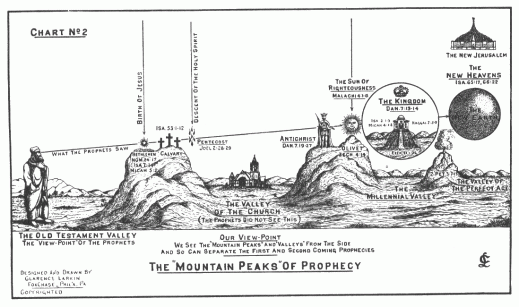
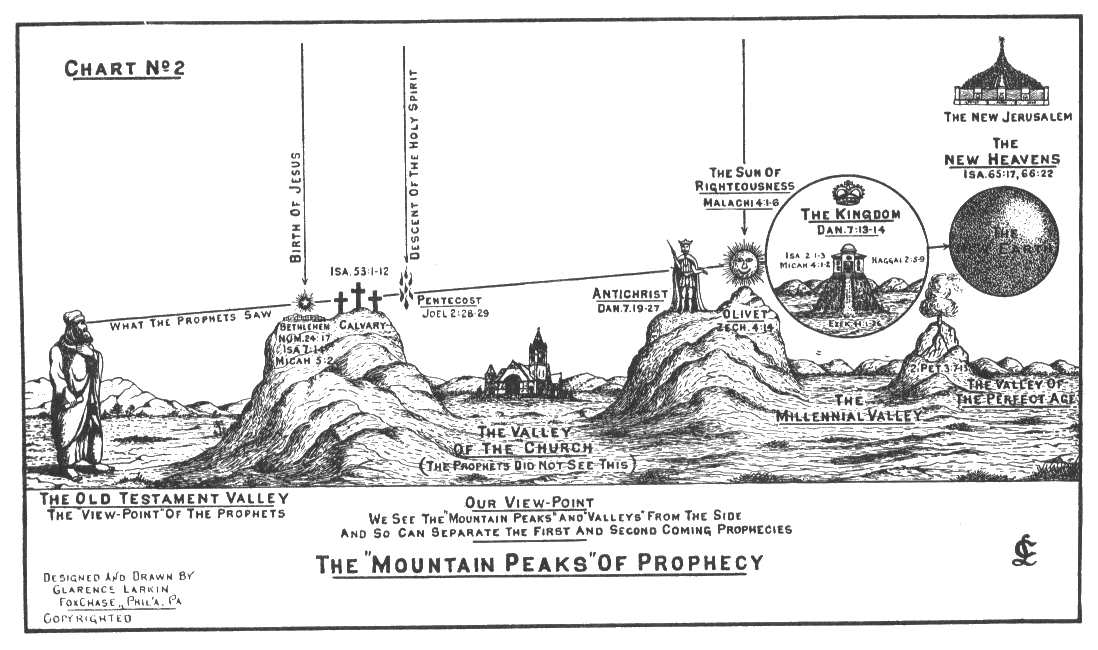
This picture represents what the prophets (including Jesus Christ) could see and know from the Scriptures. As you can see here the Prophets could not know or understand anything about the Church Age because God kept it a Secret from everyone until it was revealed to Paul and the other Apostles by the ascended Christ.
Rom 16:25-27
And to Him who is able to establish you, according to my good news, and the preaching of Jesus Christ, according to the revelation of the secret, in the times of the ages having been kept silent,
26 and now having been made manifest, also, through prophetic (Christian) writings, according to a command of the age-during God, having been made known to all the nations for obedience of faith —
27 to the only wise God, through Jesus Christ, to him [be] glory to the ages. Amen.
YLT
Eph 3:3-5
3 that by revelation He made known to me the secret, according as I wrote before in few [words] —
4 in regard to which ye are able, reading [it], to understand my knowledge in the secret of the Christ,
5 which in other generations was not made known to the sons of men, as it was now revealed to His holy apostles and prophets in the spirit —
YLT
1 Cor 2:7-8
7 But we speak the wisdom of God in a musterion, secret, even the hidden wisdom, which God ordained before the world unto our glory:
8 Which none of the princes of this world knew: for had they known it, they would not have crucified the Lord of glory.
KJV
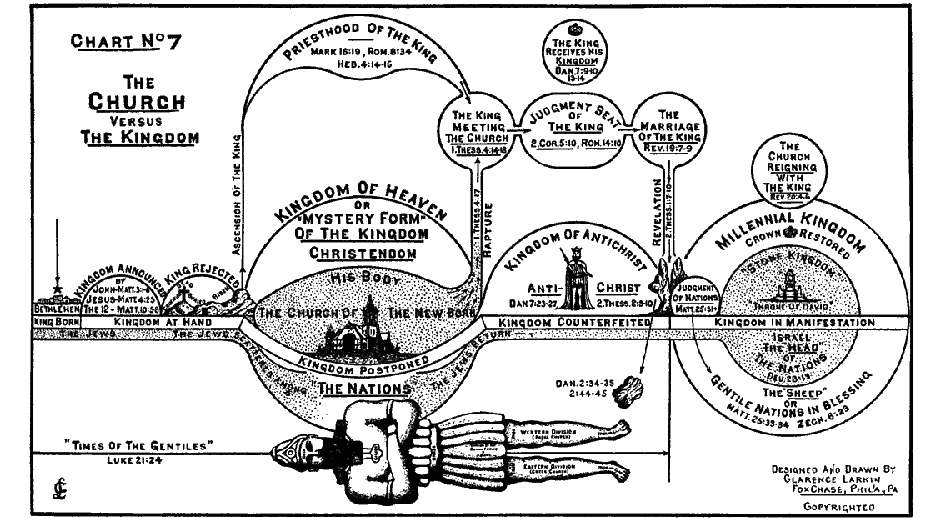
This one represents the Church of the Body of Christ versus the Kingdom of God and Christ. The resulting affect of this hidden wisdom is that the coming Kingdom which Jesus and the apostles expected soon after his ascension, would be put on hold or held in abeyance. As you can see, the Kingdom most Christians speak about as if it existed today, will not exist until after the Great Tribulation. As for now, Jesus is our Lord, not our king.
2 Peter 3:14-18
Therefore, beloved, since you look for these things, be diligent to be found by Him in peace, spotless and blameless, 15 and regard the patience of our Lord as salvation; just as also our beloved brother Paul, according to the wisdom given him, wrote to you, 16 as also in all his letters, speaking in them of these things, in which are some things hard to understand, which the untaught and unstable distort, as they do also the rest of the Scriptures, to their own destruction. 17 You therefore, beloved, knowing this beforehand, be on your guard so that you are not carried away by the error of unprincipled men and fall from your own steadfastness, 18 but grow in the grace and knowledge of our Lord and Savior Jesus Christ. To Him be the glory, both now and to the day of eternity. Amen.
NASU
This revelation is NOT to be ignored; you do so at your own destruction.
Will you be found blameless?
Are you among the untaught (unteachable) and unstable?
Are you being lead astray by the error of unprincipled men?
Are you growing in knowledge as well as grace?
The Last Week of Christ’s Life
One of the more important times of the Christian calendar is what we call Easter, yet for as much as we think we know about it, there is much to be learned. Approaching the subject seems as exhaustive as an hour of the suffering that the Lamb of God, Jesus the Messiah, experienced. It seems to me that such an important time, culminating in the resurrection of Jesus Christ, more time should be spent than a few hours in Sunday School when we were children. A key ingredient that has led to some misunderstanding, in general, of the Bible is that it is an Eastern Book, written from the mindset of an Easterner as opposed to a Westerner.
In the East a new day begins at Sunset and the pre-day at dusk. The weekly Sabbath of Saturday, for those who observe it, are in a hurry to get home on Friday, before sundown, so they can observe that holy day properly. In the West we chose 12 midnight to begin our days because it is probably a lot more consistent. 12 midnight is always 12 midnight; while sunset changes 365 days a year, not too consistent. This makes it real easy for those of us who read the Bible to lose 12 hours and sometimes even 24 of a timeline, from here and there.
Because the last week of Jesus’ life is such a detailed study I am going to pass it off to one of my Teachers, John Schoenheit, of Spirit and Truth Fellowship International.
http://www.truthortradition.com/articles/the-last-week-of-christs-life
Another related teaching of John’s is , “Did God Really Forsake Jesus Christ on the Cross?”
http://www.truthortradition.com/articles/did-god-really-forsake-jesus-christ-on-the-cross
Enjoy Holy Week, as never before!
God bless,
WHAT IS A PERSON?
This is a question that I never imagined would need answering in my Christian walk with God and my Lord, Jesus Christ.
First of all, how is “person” defined? In my “American Heritage Dictionary of the English Language” it is defined as:
- A living human being, especially as distinguished from an animal or thing.
- The composite of characteristics that make up an individual personality.
- An individual of some specified character.
- The living body of a human being
- (my addition) consists of flesh and bones, have a body and are called people
From here we need to define “individual:”
- a. Of or relating to a single human being. b. By or for one person
- Existing as a distinct entity; single; separate.
- Distinguished by particular attributes; distinctive.
- Indivisible as an entity; inseparable
The reason this question has arisen is because of the subject of the Holy Spirit. There is an overwhelming amount of misunderstanding on this subject. The primary reason for this misunderstanding is because of a three letter word that is called an article in English grammar. An “article” is defined as:
- Any of a class of words used to signal nouns and to specify their application. In English the articles are a and an (indefinite articles) and the (definite article).
Yes, you guessed it we are talking about the article “THE.” The misplacement of this little word has caused no end of confusion. Translators are responsible for this and they will one day answer for it. What the definite article “the” does when it comes to the subject of holy spirit, is determine the capitalization or not, of the words that follow it. Some people might say, “what’s the big deal, what difference does it make?” Well, in biblical circles it is a really big deal. For example, when there is no article “the” before the words pneuma hagion, spirit or ghost and holy, it should not be capitalized, distinguishing it from when the article does appear. The difference between the Holy Spirit and holy spirit, is the Giver and the gift. God is holy and God is spirit = the Holy Spirit and that which God gives to all who believe in the Lord Jesus Christ is holy spirit, his gift. God gives what “HE” is.
This brings us to defining spirit, what is it? In the Greek it is the word pneuma from which we get the word pneumatic. Pneuma is used 379 times in the New Testament and it means;
- NT:4151 from NT:4154; a current of air, i.e. breath (blast) or a breeze; by analogy or figuratively, a spirit, i.e. (human) the rational soul, (by implication) vital principle, mental disposition, etc., or (superhuman) an angel, demon, or (divine) God, Christ’s spirit, the Holy Spirit: (Biblesoft’s New Exhaustive Strong’s Numbers and Concordance with Expanded Greek-Hebrew Dictionary. Copyright © 1994, 2003, 2006 Biblesoft, Inc. and International Bible Translators, Inc.)
Pneumatic tools are powered by compressed air. Air is everywhere and generally it is invisible, untouchable and unseen. Why is God called the Holy Spirit? Because there are a lot of Unholy spirits. All spirits are not holy, which is why God distinguishes “Himself” from them, with the use of Holy. You will notice how I have been putting male pronouns in reference to God in quote marks. The reason I am doing this is to note that these references are in fact figures of speech. God is spirit and spirit has not flesh and bones as people have: Jesus says in Luke 24:37-39:
37 But they were terrified and affrighted, and supposed that they had seen a spirit.
38 And he said unto them, Why are ye troubled? and why do thoughts arise in your hearts?
39 Behold my hands and my feet, that it is I myself: handle me, and see; for a spirit hath not flesh and bones, as ye see me have.
KJV
The figure of speech Anthroopatheia or Condescension, is ascribing to God what belongs to human and rational beings. Furthermore, Moses tells us that “God is not a man (‘iysh, a man as an individual or a male person), that he should lie; neither the son of man (‘adam, a human being), that he should repent.” Nu 23:19. Any and all human characteristics attributed to God or the Holy Spirit is a figure of speech and not literal.
Therefore there is no way in God’s creation that The Holy Spirit, The Giver, who is God Himself can be a Person, a living human being with flesh and bones. To believe that a spirit of any kind, holy or not, is a person, is foundational-less thinking. It is completely illogical and God is all about logic.
Okay, let us take a look at the first usage of the words “Holy Spirit or Ghost” used together, Matt 1:18 Now the birth of Jesus Christ was on this wise: When as his mother Mary was espoused to Joseph, before they came together, she was found with child of the Holy Ghost. KJV You will notice that I italicized the words added by the translators. The article “the” before the words Holy Ghost was added, therefore it should read “she was found with child of holy spirit.”
Let’s look at the 2nd usage in Matt 1:20b “….for that which is conceived in her is of the Holy Ghost.” Here again “the” was added. It should read, “for that which is conceived in her is of holy spirit.”
Let’s look at the 3rd usage (you can see that I am not “cherry-picking” verses to support my position). Matt 3:11: I indeed baptize you with water unto repentance: but he that cometh after me is mightier than I, whose shoes I am not worthy to bear: he shall baptize you with the Holy Ghost, and with fire:”It should read: I indeed baptize you with water unto repentance: but he that cometh after me is mightier than I, whose shoes I am not worthy to bear: he shall baptize you with holy spirit and fire:” If we were baptized by the Holy Spirit, we would be disintegrated! Instead we are baptized with a part of that which He is, not “He Himself.” (Note here another misunderstood concept, holy spirit and fire is the figure speech Hendiadys, which means Two for One; two words used but one thing meant).
Now let’s look at what we get from God who is the Holiest of the Spirits: Luke 11:13 If ye then, being evil, know how to give good gifts unto your children: how much more shall your heavenly Father give the Holy Spirit to them that ask him? KJV There is no article “the” in the texts so it should read “give holy spirit,” the gift. Luke 1:15 says John the Baptist would be filled with the Holy Ghost from his mother’s womb. No article “the” there either. He was filled with the gift of holy spirit. The words “holy ghost” are used 90 times and it’s your job to figure out how many of these are the Giver and how many are the Gift.
You need a Greek Interlinear or a PC Bible program like mine from Biblesoft in order to see these fraudulent errors that Satan has perpetrated through translators of the Bible. Our Bibles today are not the Word of God as God originally moved holy men of God, who wrote it, but with Computer Bible software, we can get back to the original God-breathed Word. This is one reason why the Church needs Teachers like me who have a ministry to convey the truth. It is not my responsibility that you learn anything, that is up to you and God. I plant and I water, but it is God who gives the increase.
You can reject everything I say but once I have said it and once you have read it, you are responsible to God for it, just as I am. You can be rewarded at the Bema for believing it or suffer loss for rejecting it. The majority will not rule at the Judgment Seat of Christ as we will all stand alone. You will not be able to blame what you believed here on earth on your pastor, your spouse or anyone else.
To see more on Figures of speech in the Bible go to the link below to see that I am not the only good Teacher around:
http://www.ewbullingerbooks.com/Catalog/e-w-bullinger-figures-of-speech-used-in-the-bible.htm
GOD BLESS!
The Birth of Christ–Out in the Cold Stable or In a warm House?
(The guestchamber in those days was a room adjacent to the house for the lodging of guests. These days some people have Guest-houses, while others may have Guest-rooms. The Greek word this is translated from is used 1 other time in Luke and once in Matthew. In both instances it is translated “guestchamber” in the King James Version: Mark 14:14
And wheresoever he shall go in, say ye to the goodman of the house, The Master saith, Where is the guestchamber, where I shall eat the passover with my disciples?
KJV; Luke 22:11
And ye shall say unto the goodman of the house, The Master saith unto thee, Where is the guestchamber, where I shall eat the passover with my disciples? KJV)
Joseph and Mary were not out in the cold with no place to go. They were at a friend’s house or at the very least a friend of a friend. They were like royalty, direct descendants of King David and they were in the city of David. They didn’t just arrive but had been there at least a few days already . Anyone would have been glad to have them in their home, let alone the fact Mary was in her 9th month of pregnancy. John Schoendeit of Spirit and Truth Fellowship adds this light on the subject:
“Another thing we must understand about houses in the East is that it was common for people to bring their animals, such as the family donkey, a couple of milk goats, or a cow or two, into the home at night. Such animals were very valuable, and the people brought them in at night to keep them from being stolen and to protect them from harm. Also, the animals added heat to the house, which would be very welcome on chilly nights. The woman in Endor who King Saul visited at night had her calf in the house with her: “And the woman had a fat calf in the house” (1 Sam. 28:24, KJV). [10] Of course, if the family were shepherds or herdsmen, they would not bring the whole flock or herd into the house, but would have a family member or hired guard watch them in the field, just as the shepherds were in the field on the night Jesus was born.
It was a common practice to raise the floor of the part of the house where the family lived, and keep the animals in an area that was a little lower. [11] Knowing this helps us understand Luke 2:6 and also where that idea that Jesus was born in a stable came from. Jesus was laid in a manger, which is an open trough, box, or bin, where the animal food was placed so the animals could feed easily. In Western society, mangers are in barns or stables, so if Jesus was laid in a manger it made sense he was born in a stable. However, in Eastern society, where the animals grazed outside during the day and were brought into the house at night, the manger was in the house. Having the manger in the house kept the animals calm and contented in the tighter quarters of the house, just as many modern farm animals have a feeding trough in their stall stay calm and content.
Everyone knew the manger was in the house, so when the Bible says that Jesus was laid in a manger “because” there was no space in the guest room, any Easterner would understand perfectly that the guest room was full so Jesus was born in the main part of the house where the family and animals stayed. Sometime after his birth he was safely placed in the manger, which would have been filled with clean hay or straw and would have been the perfect size for him. This was not to demean him in any way, but to care for him. The protective walls of the manger kept him safely guarded and away from busy feet and a bustling household, as well as warm and protected from any drafts or cold air in the home.
Another thing that helps us understand the Christmas story is understanding Eastern hospitality. In the East, guests were given special treatment of all kinds, including behavior that seems very extreme to us. For example, in the record of Lot and the two strangers, Lot would have handed over his own daughters to the mob before surrendering his guests (Gen. 19:8). Similarly, the people with whom Joseph and Mary stayed would never displace their guests from the guest room, but instead would inconvenience themselves, graciously bringing the couple into their living space.”
See more athttp://www.truthortradition.com/articles/retelling-the-christmas-story.
MERRY CHRISTMAS!

 Home of the Rightly Divided Word