The Elusive Kingdom of God
I used to think saying the Lord’s Prayer was ludicrous until I realized that we were still praying for God’s kingdom to come. Jesus taught his Jewish followers to pray for God’s kingdom to come and Christians today are still doing the same. Why? Because it has not yet come. Let’s see what scriptures teach us about it.
Acts 1:1-6
The former treatise have I made, O Theophilus, of all that Jesus began both to do and teach,
2 Until the day in which he was taken up, after that he through (no article the) holy spirit had given commandments unto the apostles whom he had chosen: To whom also he shewed himself alive after his passion by many infallible proofs, being seen of them forty days, and speaking of the things pertaining to the kingdom of God: And, being assembled together with them, commanded them that they should not depart from Jerusalem, but wait for the promise of the Father, which, saith he, ye have heard of me. For John truly baptized with water; but ye shall be baptized with (no article the) holy spirit not many days hence. When they therefore were come together, they asked of him, saying, Lord, wilt thou at this time restore again the kingdom to Israel?
Until the day Jesus ascended into Heaven his followers wondered when the kingdom was going to be restored to Israel. Obviously it had not been up to that time.
In Acts 14, it is implied that the Kingdom of God is something to be “entered into:” Acts 14:22
Confirming the souls of the disciples, and exhorting them to continue in the faith, and that we must through much tribulation enter into the kingdom of God. KJV
It’s the word eiserchomai, to come or go into. Here it says much tribulation is required to go into the kingdom. In the following verses the kingdom of God is something to be “inherited:” 1 Cor 6:9-10:
9 Know ye not that the unrighteous shall not inherit the kingdom of God? Be not deceived: neither fornicators, nor idolaters, nor adulterers, nor effeminate, nor abusers of themselves with mankind, nor thieves, nor covetous, nor drunkards, nor revilers, nor extortioners, shall inherit the kingdom of God. KJV
1 Cor 15:50 confirms the previous scriptures:
Now this I say, brethren, that flesh and blood cannot inherit the kingdom of God; neither doth corruption inherit incorruption. KJV
Another verse implying that the kingdom is something to be inherited: Gal 5:19-21
Now the works of the flesh are manifest, which are these; Adultery, fornication, uncleanness, lasciviousness, Idolatry, witchcraft, hatred, variance, emulations, wrath, strife, seditions, heresies, Envyings, murders, drunkenness, revellings, and such like: of the which I tell you before, as I have also told you in time past, that they which do such things shall not inherit the kingdom of God.
Here is the next to last usage of the koG: Col 4:11:
And Jesus, which is called Justus, who are of the circumcision. These only are my fellow-workers unto the kingdom of God, which have been a comfort unto me. KJV
“Unto” the kingdom is the same word as “into” in the verses in 1 Cor. 6, come “into,” eis.
I think it is very clear from scripture that the kingdom of God is not something we are in, but something that is still in the future. Jesus came to bring it to Israel, but the promises to Israel are being held in abeyance. We too will share in that promise, in the Millennial Kingdom, after the Rapture of the Church.
People are Souls, They have a Heart, but are Soul-less

Most of us have likely heard the expression “Bob is an old soul or Sandy is a young soul,” right? We don’t hear people say “John ‘has’ a young soul.” We do hear them say that so and so is young at heart, though.
In the Hebrew Scriptures Strong’s defines Nephesh as a breathing creature, i.e. animal of vitality; Brown-Driver-Briggs Hebrew Lexicon as a soul, self, life, a creature, a person, an appetite, a mind, a living being, a desire, an emotion, a passion. As you can see from the definition whatever it is, it is alive and vital.
For the sake of this teaching I am going to be using the Darby Bible since it uses the words “living soul” twelve times. The first usage is:
Gen 1:21 “And God created the great sea monsters, and every living soul that moves with which the waters swarm, after their kind, and every winged fowl after its kind. And God saw that it was good.” Most other popular versions use the word “creature or “thing” instead of soul.
What does every living soul do? They move! Whether they creep, crawl, swim or fly, they are living souls. I never really thought about worms, ants, bees or snails as being living souls, but I guess they are!
The second usage (and so on):
Gen 1:30 “and to every animal of the earth, and to every fowl of the heavens, and to everything that creepeth on the earth, which is a living soul, every green herb for food. And it was so”
Gen 2:7 “And Jehovah Elohim formed Man, dust of the ground, and breathed into his nostrils the breath of life; and Man became a living soul.”
Gen 2:19 “And out of the ground Jehovah Elohim had formed every animal of the field and all fowl of the heavens, and brought [them] to Man, to see what he would call them; and whatever Man called each living soul, that was its name.”
Gen 9:10 “and with every living soul which is with you, fowl as well as cattle, and all the animals of the earth with you, of all that has gone out of the ark — every animal of the earth.”
Gen 9:12 “And God said, This is the sign of the covenant that I set between me and you and every living soul that is with you, for everlasting generations:’
Gen 9:15-16 “and I will remember my covenant which is between me and you and every living soul of all flesh; and the waters shall not henceforth become a flood to destroy all flesh. And the bow shall be in the cloud; and I will look upon it, that I may remember the everlasting covenant between God and every living soul of all flesh that is upon the earth.
Lev 11:10 “but all that have not fins and scales in seas and in rivers, of all that swarm in the waters, and of every living soul which is in the waters — they shall be an abomination unto you.”
Lev 11:46 “This is the law of cattle, and of fowl, and of every living soul that moveth in the waters, and of every soul (creature) that crawleth on the earth;”
1 Cor 15:45 “Thus also it is written, The first man Adam became a living soul; the last Adam a quickening spirit.”
Rev 16:3 “And the second poured out his bowl on the sea; and it became blood, as of a dead man; and every living soul died in the sea.”
The following verses are from a Bible called The Message. Some of you OG’s may remember seeing it but it is one of the seventeen Bibles in my PC Bible Program.
1 Kings 15:29 “As soon as he was king he killed everyone in Jeroboam’s family. There wasn’t a living soul left to the name of Jeroboam; Baasha wiped them out totally,”
2 Chron 20:24 “As Judah came up over the rise, looking into the wilderness for the horde of barbarians, they looked on a killing field of dead bodies — not a living soul among them.”
Job 12:10 “Every living soul, yes, every breathing creature?”
Acts 3:22-23 “Moses, for instance, said, ‘Your God will raise up for you a prophet just like me from your family. Listen to every word he speaks to you. Every last living soul who refuses to listen to that prophet will be wiped out from the people.’ “
At the risk of becoming exhaustive I am compelled to give you every usage I could find on the 2 words. These verse are from the good old Catholic Bible, The Douay-Rheims. The first one we have already covered but I had to include it because someone mentioned something about adding water to dust to from the body of man. The Monks already took care of that!
Gen 2:7 “And the Lord God formed man of the slime of the earth: and breathed into his face the breath of life, and man became a living soul.
Gen 8:21 “And the Lord smelled a sweet savour, and said: I will no more curse the earth for the sake of man: for the imagination and thought of man’s heart are prone to evil from his youth: therefore I will no more destroy every living soul as I have done.”
Now for some of you younger souls, there are 400 more usages of soul in the Hebrew Scriptures. Feel free to have at ‘em. I’m just going to show a few that pop out at me.
Lev 5:1-4 “And if a soul sin, and hear the voice of swearing, and is a witness, whether he hath seen or known of it; if he do not utter it, then he shall bear his iniquity. 2 Or if a soul touch any unclean thing…………3 Or if he touch the uncleanness of man…………4 Or if a soul swear, pronouncing with his lips to do evil, or to do good, whatsoever it be that a man shall pronounce with an oath, and it be hid from him; when he knoweth of it, then he shall be guilty in one of these. KJV
Deut 12:20-21 “When the Lord thy God shall enlarge thy border, as he hath promised thee, and thou shalt say, I will eat flesh, because thy soul longeth to eat flesh; thou mayest eat flesh, whatsoever thy soul lusteth after. 21 ………whatsoever thy soul lusteth after. KJV
To be honest and fair, there are many verses that would incline one to believe that the soul is something distinctly independent of the person. Here is just one:
Isa 29:8 “It shall even be as when an hungry man dreameth, and, behold, he eateth; but he awaketh, and his soul is empty: or as when a thirsty man dreameth, and, behold, he drinketh; but he awaketh, and, behold, he is faint, and his soul hath appetite: so shall the multitude of all the nations be, that fight against mount Zion. KJV
Here is what one Commentary says about it: “[It shall even be …] This is a most striking figure representing the earnest desire of the Assyrian to possess the city of Jerusalem, and his utter disappointment.
(from Barnes’ Notes, Electronic Database Copyright © 1997, 2003, 2005, 2006 by Biblesoft, Inc. All rights reserved.)
Who would have thought that?
BTW, I looked up dead soul and couldn’t find anything. But, nothing is more convincing than looking at the 78 times soul(s) plural was used in the KJV! Then you will become further convinced that souls are living “things” that take breath, including fish, worms and bugs! You could even say, “If it shits, it’s a living soul!”
Souls Plural
Gen 46:15 These be the sons of Leah, which she bare unto Jacob in Padan-aram, with his daughter Dinah: all the souls of his sons and his daughters were thirty and three. KJV
Gen 46:18 These are the sons of Zilpah, whom Laban gave to Leah his daughter, and these she bare unto Jacob, even sixteen souls. KJV
Gen 46:22 These are the sons of Rachel, which were born to Jacob: all the souls were fourteen.
Gen 46:25 These are the sons of Bilhah, which Laban gave unto Rachel his daughter, and she bare these unto Jacob: all the souls were seven.
26 All the souls that came with Jacob into Egypt, which came out of his loins, besides Jacob’s sons’ wives, all the souls were threescore and six;
27 And the sons of Joseph, which were born him in Egypt, were two souls: all the souls of the house of Jacob, which came into Egypt, were threescore and ten.
Acts 7:14 Then sent Joseph, and called his father Jacob to him, and all his kindred, threescore and fifteen souls. KJV
Acts 27:37 And we were in all in the ship two hundred threescore and sixteen souls. KJV
1 Peter 3:20 Which sometime were disobedient, when once the longsuffering of God waited in the days of Noah, while the ark was a preparing, wherein few, that is, eight souls were saved by water. KJV
Acts 2:41 Then they that gladly received his word were baptized: and the same day there were added unto them about three thousand souls.
Acts 7:14 Then sent Joseph, and called his father Jacob to him, and all his kindred, threescore and fifteen souls.
Since Bob mentioned the Apocraphal and extra Canonical Books I thought it would be cool to look at a few of those as well.
Judith 7:26-27 Now therefore call them unto you, and deliver the whole city for a spoil to the people of Holofernes, and to all his army. For it is better for us to be made a spoil unto them, than to die for thirst: for we will be his servants, that our souls may live, and not see the death of our infants before our eyes, nor our wives nor our children to die. KJV
Judith seems to be a pretty smart lady. I’ve always said that no one is any good to God dead! Here she would rather be someone’s spoil than starve to death!
Wisdom 2:22-3:1 As for the mysteries of God, they knew them not: neither hoped they for the wages of righteousness, nor discerned a reward for blameless souls. For God created man to be immortal, and made him to be an image of his own eternity. Nevertheless through envy of the devil came death into the world: and they that do hold of his side do find it. But the souls of the righteous are in the hand of God, and there shall no torment touch them. KJV
Being a soul as opposed to having one eliminates a whole bunch of things which we know are not true, like soul sleep, transmigration of the soul, or soul travel.
Fallen Angels
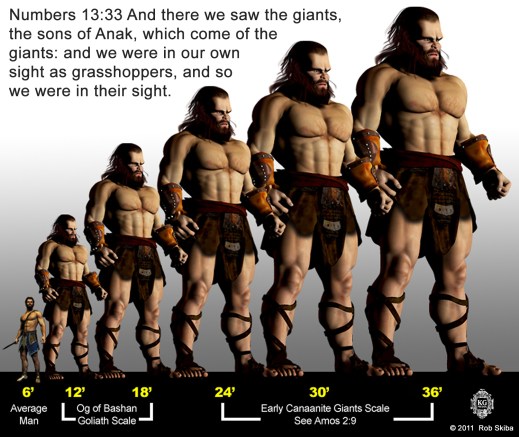
Most of us have heard about “fallen angels” even though the Bible does not literally support it. If you research “fallen” you will only find one reference to an angel in Is.14:12, which is a prophecy of something to come. This scripture refers the “the Shining One, the Morning Star.”
Isa 14:12
“How you have fallen from heaven,
O star of the morning, son of the dawn! NASU
(The KJV adds the name Lucifer, but there is no such name in the most correct manuscripts).
The reason this verse is still future is because Rev. 12:9 is still future.
9 And the great dragon was thrown down, the serpent of old who is called the devil and Satan, who deceives the whole world; he was thrown down to the earth, and his angels were thrown down with him.
NASU
“The fallen angels” refers to those mentioned in Jude 6 and 2Pe.2:4.
Jude 6
And angels–those who did not keep the position originally assigned to them, but deserted their own proper abode–He reserves in everlasting bonds, in darkness, in preparation for the judgement of the great day. Weymouth. This seems to be a free will decision to abandon (desert) their own dwelling place and because they did,
2 Peter 2:4
For God did not spare angels when they had sinned, but hurling them down to Tartarus consigned them to caves of darkness, keeping them in readiness for judgement. Weymouth
Because of their own actions, God cast them out of Heaven; they didn’t fall, they were thrown out!
What sin did they did commit to cause this? For those who may not know we can find that answer in Genesis.
Gen 6:1-4
Now it came about, when men began to multiply on the face of the land, and daughters were born to them, 2 that the sons of God (angels) saw that the daughters of men were beautiful; and they took wives for themselves, whomever they chose. 3 Then the Lord said, “My Spirit shall not strive with man forever, because he also is flesh; nevertheless his days shall be one hundred and twenty years.” 4 The Nephilim were on the earth in those days, and also afterward, when the sons of God came in to the daughters of men, and they bore children to them. Those were the mighty men who were of old, men of renown. NASU
Gen 6:4
4 The Nephilim were on the earth in those days and also later. That was when the sons of God had sexual relations with the daughters of human beings. These women gave birth to children, who became famous and were the mighty warriors of long ago. NCV
The offspring of these angels were/are the Nephilim. Goliath was a Nephilim, a member of a super race of people, continually evil, mighty warriors and famous men of renown. Nimrod was another. This is the sin that these particular angels committed. They have been in Tartarus ever since the Flood.
Israel and the New Covenant
Some things Christians believe never fail to amaze me. One of them is what is named “the New Covenant.” Covenants have been and always will pertain to Israel, not the Church of God in Christ Jesus.
The Book of Hebrews will be a lot more familiar to a Hebrew than to a Gentile. The language and the words used will be much more understandable to them. Nevertheless, this “new” covenant mentioned in detail 14 times from 8:6 to 13:20 will leave even former Gentile, now Christian believers, with no doubt to whom this covenant applies.
8:6 tells us that Jesus will be the mediator of this new covenant. Verse 8 begins a quote of Jeremiah 31:31-34 which goes like this:
31 “Behold, days are coming,” declares the Lord, “when I will make a new covenant with the house of Israel and with the house of Judah,……NASB
It is pretty clear “to whom” this new covenant applies. This prophecy is yet to come to be fulfilled.
8:10 and 10:16 says “After those days,”—-after what days? “Those days” aren’t just any days, but refer to the Day(s) of the LORD, the days of the vengeance of our God.
Matt 24:19
And woe unto them that are with child, and to them that give suck in “those” days!
KJV
Matt 24:22
And except those days should be shortened, there should no flesh be saved: but for the elect’s sake “those” days shall be shortened.
KJV
Matt 24:29-30
Immediately after the tribulation of “those” days shall the sun be darkened, and the moon shall not give her light, and the stars shall fall from heaven, and the powers of the heavens shall be shaken:
30 And then shall appear the sign of the Son of man in heaven: and then shall all the tribes of the earth mourn, and they shall see the Son of man coming in the clouds of heaven with power and great glory.
KJV
Yes, after these days of the Great Tribulation, will this new covenant be enacted for the faithful of Israel who live through it and those who are raised from the dead at the First Resurrection, that of the Just.
Covenants apply to Jews, not Gentiles nor the Church of God. God Bless!
Fred S. Wolfe
72 Virgins or The Lake of Fire?
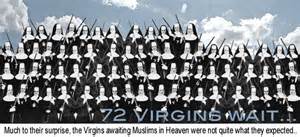
” Islamo Nazi’s are in for a big surprise!”
IMHO, I believe the biggest lie in practically all world religions is that there is “Life immediately after Death.” Muslims for example pattern much of what they believe after the Old Testament of the Bible and specifically the Torah. Christians and Jews each believe in the Resurrection of/from the Dead. What would be the point in believing in the resurrection of the dead if the dead were already alive in Heaven or as some believe in Paradise?
From what I have read Jesus Christ, the “monogenetic” son of God, is the only human being whose flesh was not allowed to rot in the grave, Sheol. Until the Administration of the Secret, all any believer had to look forward to after death was the resurrection of the Just; it was the Jews one, big hope. I think Martha said it best when speaking to Jesus of her dead husband Lazarus, “Martha saith unto him, I know that he shall rise again in the resurrection at the last day.”–John 11:24–KJV
In John 11, Lazarus had been dead 4 days and stunk to high heaven! But, why wasn’t he already in heaven or Paradise? Heck, he was one of Jesus’ best friends. If one of the malefactors crucified with Jesus was going to be in Paradise immediately after his death, surely Lazarus would be too, right? If someone who robbed people by threatening their lives was going to be in Paradise immediately following their death, certainly a righteous believer whom the Lord Jesus loved would be. But, the fact of the matter is, neither of them were. And no one who has ever drawn breath on this earth besides Jesus is!
1 Cor 15:20-23–But now is Christ risen from the dead, and become the firstfruits of them that slept (dead in the grave, Sheol). For since by man came death, by man came also the resurrection of the dead. For as in Adam all die, even so in Christ shall all be made alive. (When?) But every man in his own order: Christ the firstfruits; afterward they that are Christ’s at his coming. Aside from the Gathering Together, episunagoge, of the Church of God, the resurrection “at his coming” will be that of the Just. Luke 14:14–And thou shalt be blessed; for they cannot recompense thee: for thou shalt be recompensed at the resurrection of the just. KJV
Acts 24:14-15–But this I confess unto thee, that after the way which they call heresy, so worship I the God of my fathers, believing all things which are written in the law and in the prophets: and have hope toward God, which they themselves also allow, that there shall be a resurrection of the dead, both of the just and unjust. This means that someday everyone who has ever lived will raised from the dead, some to everlasting life and others to the 2nd death. Rev 20:5-6 says,
But the rest of the dead lived not again until the thousand years were finished. This is the first resurrection. Blessed and holy is he that hath part in the first resurrection (the Just): on such the second death hath no power, but they shall be priests of God and of Christ, and shall reign with him a thousand years. KJV
Islamic extremists who kill themselves while murdering others have nothing to look forward to but the second death. They will certainly be among those who are treated to a swim in a heated pool after the resurrection of the Unjust. Rev 20:12-14
And I saw the dead (not the living), small and great, stand before God; and the books were opened: and another book was opened, which is the book of life: and the dead were judged out of those things which were written in the books, according to their works. And the sea gave up the dead which were in it; and death and hell, sheol, delivered up the dead which were in them: and they were judged every man according to their works. And death and hell were cast into the lake of fire. This is the second death. And whosoever was not found written in the book of life was cast into the lake of fire. (Can you see where the dead are? They are not in heaven or paradise). The dead are in the sea or on land, in the grave, nowhere else.
Rev 21:8–But as for the cowardly, the faithless, the detestable, as for murderers, the sexually immoral, sorcerers, idolaters, and all liars, their portion will be in the lake that burns with fire and sulfur, which is the second death. ESV
Death is an enemy and always will be. Death will not be destroyed until after the Millennial Kingdom as you see above. We were not created to die, but to live forever. When we make Jesus, Lord and believe God, YHWH, raised him from the dead we will receive eternal life. After death, we will all sleep with our father’s, just like everyone else, but Jesus! God bless!

I CAN HARDLY WAIT TO DIE FOR CHRIST or Allah! (Part II)

Part II of …..DYING FOR CHRIST or Allah
Phil 1:23
For I am in a strait betwixt two, having a desire to depart, and to be with Christ; which is far better:
Webster
23 But I am pressed by both, having the desire for (the) departure and being with Christ, [for] [it is] very much better,
Darby
The following is taken from Adam Clarke’s Commentary, Electronic Database. Copyright © 1996, 2003, 2005, 2006 by Biblesoft, Inc. All rights reserved:
[For I am in a strait betwixt two] Namely, the dying now, and being immediately (in a sense of time at the Rapture) with Jesus; or living longer to preach and spread the Gospel, and thus glorify Christ among men. ( if I died right now. the next thing I would be aware of is the Rapture!)
[Having a desire to depart, and to be with Christ] Teen epithumian echoon eis to analusai. It appears to be a metaphor taken from the commander of a vessel, in a foreign port, who feels a strong desire analusai, to set sail, and get to his own country and family; but this desire is counterbalanced by a conviction that the general interests of the voyage may be best answered by his longer stay in the port where his vessel now rides; for he is not in dock, he is not aground, but rides at anchor in the port, and may any hour weigh and be gone. Such was the condition of the apostle: he was not at home, but although he was abroad it was on his employer’s business; he wishes to return, and is cleared out and ready to set sail, but he has not received his last orders from his owner, and whatever desire he may feel to be at home he will faithfully wait until his final orders arrive. (Nicely put, eh?)
The word depart, analusai, is only used in one other place in the Bible in Luke 12:36 in regards to Christ’s return, specifically his 2nd Coming for Israel:
36 And ye yourselves like unto men that wait for their lord, when he will return from the wedding; that when he cometh and knocketh, they may open unto him immediately.
KJV
1 Thess 4:13-17 But we do not want you to be uninformed, brethren, about those who are asleep (dead), that you may not grieve, as do the rest who have no hope. 14 For if we believe that Jesus died and rose again, even so God will bring with Him those who have fallen asleep in Jesus. For this we say to you by the word of the Lord, that we who are alive, and remain until the coming of the Lord, shall not precede those who have fallen asleep (the dead). 16 For the Lord Himself will descend from heaven with a shout, with the voice of the archangel, and with the trumpet of God; and the dead in Christ shall rise first. NASB
God can’t bring anyone with Jesus back to heaven, if everyone is already there! Come on people, the Bible has to make sense. There is no life immediately after death; there is no transmigration of the soul. (I’m not sure this knowledge would make any difference to the Islamo-facists group called ISIS, but it should). When Jesus drew his last breath, BAM he was dead! His soul no longer existed anywhere; no breath = no life. Anyone teaching anything contrary to this is in error. Every mortal who has ever lived and died with the exception of Jesus Christ is Resting in Peace.
R.I.P.
(TBC)
I CAN HARDLY WAIT TO DIE FOR CHRIST or Allah! (PART I)

In light of the many recent be-headings and murders of Christians by radicalized Muslims or Islamic Extremists, some in the Church are teaching that if you are in the place God wants you to be and this happens to you, then it is “gain,” because even Paul said it was better to be with Christ than to be ministering here on earth or so it is taught. Who really benefits when a Christian dies? Both Muslims and Christians hold the erroneous belief in life immediately after death. I think there would far fewer suicide bombers if they knew the truth.
Paul said in Phil 1:21 “For to me to live is Christ, and to die is gain.” When we look at this verse as it stands alone it leaves us with the impression that death is something to be gained, yet we know that death is and always will be an enemy; the greatest enemy of life. No one gains anything by being dead; not God, not Jesus and certainly not you. In order to “gain” a proper understanding of the preceding verse it must be seen in its context. In its context we must go back and read from the beginning of the chapter to the end of the Epistle. In verse 6 we read:
Phil 1:6 Being confident of this very thing, that he which hath begun a good work in you will perform it until the day of Jesus Christ:
Phil 1:10 That ye may approve things that are excellent; that ye may be sincere and without offence till the day of Christ;
Phil 1:20 According to my earnest expectation and my hope, that in nothing I shall be ashamed, but that with all boldness, as always, so now also Christ shall be magnified in my body, whether it be by life, or by death.
We can see that the context preceding verse 21 is “the day of Jesus Christ” when he returns to gather us together to heaven. This was Paul’s earnest expectation and hope and should be ours as well. The words “earnest expectation,” is the Greek word apokaradokia, to watch with intense anticipation, and is used in one other place in regards to the creation:
Rom 8:18-19 For I consider that the sufferings of this present time are not worthy to be compared with the glory which shall be revealed in us. 19 For the earnest expectation of the creation eagerly waits for the revealing of the sons of God. NKJV
When are the sons of God revealed? When they/we return with Jesus for the Battle of Armageddon.
The second word Paul uses in conjunction with earnest expectation is his “hope,” elpis. Hope is often associated with the return of Jesus Christ:
Col 1:5 because of the hope laid up for you in heaven, NASB
1 Thess 2:19-20 For who is our hope or joy or crown of exultation? Is it not even you, in the presence of our Lord Jesus at His coming? 20 For you are our glory and joy. NASB
Phil 1:23
For I am in a strait betwixt two, having a desire to depart, and to be with Christ; which is far better:
Webster
(TBC, see Part II)
Part IV of the Apocalupsis of John, the Book called Revelation
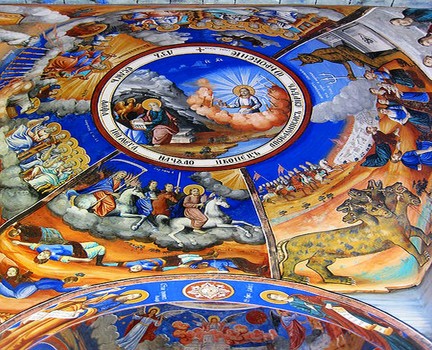
In the preceding 3 posts I have established beyond any doubt that the miscalled “churches” in The Apocalupsis of John are in reality assemblies or congregations of Jews, members of the Nation of Israel. To give you an example of how unsound some believers can be, a woman, whose blog I used to follow, said to me, “If Jesus called them churches, then that’s what they are!” Unfortunately Jesus has had nothing to do with how translators have chosen to translate most of the words in the Bible. Out of 17 Bible versions or translations in my PC Bible program only these 3 translate ecclesia properly:
Rev 1:4
John to the seven assemblies that [are] in Asia:
YLT- Young’s Literal Translation
Rev 1:4
4 John to the seven assemblies
Darby
Rev 1:4
4 John, to the seven assemblies that are in Asia:
WEB- World English Bible
If you are a serious workman of the Word or want to be you must invest in some PC Bible program or buy a lot of Bibles! On my way home from NY last Sunday by way of Chicago I had the opportunity to sit next to a young Jewish girl who had recently become a Christian. She was very well versed in the “mainstream” doctrines of Christianity. She was surprised to hear many things I had to say about beliefs she held and took a copious amount of notes on her phone. I was able to show her from the Scriptures (on her phone) passages which substantiated what I had to say, but she could not find one Scripture to substantiate anything she believed! Everything she believed hear-say and much of that was heresy!
She was even astonished to see from 1 Corinthians 10:32 that the apostle Paul established that there are only 3 types of people in the world; Jews, Gentiles and the Church of God. She was equally surprised to see these verses:
Gal 3:28-29
There is neither Jew nor Greek, there is neither bond nor free, there is neither male nor female: for ye are all one in Christ Jesus.
29 And if ye be Christ’s, then are ye Abraham’s seed, and heirs according to the promise.
KJV
She was insisting that she was a Jew for Jesus. What an absurd belief. I tried to explain to her that once a Jew or a Gentile became born again of the spirit of God by confessing Jesus as their Lord and believing God raised him from the dead, they became members of the Church of God. She could not let go of her ancestry and she could not understand how I could be of the seed of Abraham. She really imploded when I told her that Abraham was a Gentile and not a Jew!
Abram is first mentioned in Ge. 11:26; his name was changed to Abraham in Ge. 17:5. Jacob isn’t mentioned until Ge. 25:26 and his name was not changed to Israel until Ge. 32:28. The word Jew is not mentioned until the book of Esther and then it applied to a descendant of Judah. Abraham is called a Hebrew in Ge. 14:13 which means a descendant of Eber. Eber is first mentioned in Ge. 10:21. Eber lived 464 years; see Ge. 11:16.
I could go on and on, but the point you need to see is that the word Hebrew had nothing to do with Jews or Israel originally; that Israel did not exist in Ge. 11. Therefore Abraham could not have been a Jew, but rather a Gentile.
The most astonishing thing that this young Jew for Jesus had to say to me was that no one could be a Christian or a member of the Church of God without confessing and believing that Jesus was God incarnate. I asked where she got this from in the Scriptures and she did not know precisely. I showed her Romans 10:9 where it says to confess Jesus as Lord which she said means God, because God is the “Lord” God. I proceeded to show here in Acts 2:36 that God had bestowed His title as Lord upon Jesus. Jesus is my Lord, my master. Nowhere in the Pauline Epistles does it talk about the Lord God or the Lord our God. They show God as our Father and Jesus Christ as our Lord! Lord is used 241 times in the Epistles which are written directly to the Church of God and never is the title attached to God!
To the Jew God will always be the Lord; but to the Christian, Jesus is our Lord, not our God. Here is what Lord means, in case it is not clear yet:
NT:2962 kurios, kuriou, ho
he to whom a person or thing belongs, about which he has the power of deciding; master, lord
a. used universally, of the possessor and disposer of a thing, the owner Matt 20:8
b. kurios
is a title of honor, expressive of respect and reverence, with which servants salute their master, Matt 13:27; 25:20,22; Luke 13:8; 14:22, etc.;
c. this title is given:
to God, the ruler of the universe Matt 1:22 (OT, Gospels and Revelation)
to the Messiah; and that:
to the Messiah regarded universally: Luke 1:43
to Jesus as the Messiah, Acts 10:36
d. of Christ (In the Epistles)
(from Thayer’s Greek Lexicon, Electronic Database. Copyright © 2000, 2003, 2006 by Biblesoft, Inc. All rights reserved.)
Don’t be afraid to comment; I will not delete any comments but will publish all.
(More on Revelation in the next post).

 Home of the Rightly Divided Word