Who will be Saved during the Tribulation, The Day of the LORD
Christians are “rescued” from the wrath to come, therefore are raptured before the tribulation period begins. When does it begin? One would assume it begins when the Age of Grace, as you have noted, ends. When does it end? Not too many know or understand. I can only go by what I read.
When you read the Apocalypse of John, don’t read “church” for the word ekklesia. Ekklesia should never have been translated as such. It should always be translated as assembly or congregation. Church always makes one think “Christian” when it is not in the Apocalypse. Church is a German word and closest thing to it in the Bible is a transliteration (tranny for short) of kuriakos, which means belonging to the Lord. One of the main things to understand is that the Assembly of God, made up of the saved, was part of the Secret that God kept hidden from all the Hebrew Prophets including Jesus, until God revealed it to the ascended Christ, who revealed to Paul and the other Christian Prophets. This Secret was even hidden from us because the translators chose to tranny musterion into mystery, rather than translate it! The Secret is not a mystery. A mystery, to be a mystery, can never be understood, but when a Secret is revealed, it can be known.
Rev. 10:7 says: “but in the days of the voice of the seventh angel, when he is about to sound, then is finished the mystery (Secret) of God, according to the good tidings which he declared to his servants the prophets. ASV
Whoever is saved up to that point will be raptured to heaven. How long does it take to get to that point? I don’t know. What I do know is that whoever gets saved after the rapture will have to endure, remain faithful, through the tribulation to the end of it or the end of their lives, which ever comes first. Matthew 24 records what happens during this time, but I will show one verse.
Matt 24:13 But he that shall endure unto the end, the same shall be saved. KJV
You have to remember there were no Christians in Matthew, only Jews and Gentiles. The Assembly of God did not yet exist, because The Secret had not been revealed. Another word you mention is “saints.” Saints are “holy ones.” Holy Ones are also angels. We are saints as well because we are saved. Can you be a holy one without being a Christian? Of course you can. Was David saved? Abraham? Ezekiel? Yes to all, but not like we are. They won’t go to Heaven, because they won’t be resurrected until after Jesus returns with us for the Campaign of Har-Mo’ed.
Now notice this, right after the Secret of God ends in Rev. 10:7 that a 42 month period starts, 3.5 years or 1,260 days:
Rev 11:2-3 And the court which is without the temple leave without, and measure it not; for it hath been given unto the nations: and the holy city shall they tread under foot forty and two months. 3 And I will give unto my two witnesses, and they shall prophesy a thousand two hundred and threescore days, (3.5 years), clothed in sackcloth. ASV
What do you suppose they were prophesying about? What is most prophesying about? Better yet, “to whom” were they prophesying? Jews and Gentiles, because the saved “Christians” were all gone! To really grasp this, you have to comprehend that since the Hebrew Prophets knew nothing about “Christianity,” their thinking would go from the end of John to the Apocalypse of John. Prophesy concerning Israel was held in abeyance, temporarily halted, from the ascension of Jesus until after the rapture. There are no prophesies being fulfilled to day, because the Hebrew Prophets didn’t know about today!
These 2 Witnesses are prophesying about the man from Galilee. It will probably go something like this:
Acts 2:22-36 Ye men of Israel, hear these words; Jesus of Nazareth, a man approved of God among you by miracles and wonders and signs, which God did by him in the midst of you, as ye yourselves also know: 23 Him, being delivered by the determinate counsel and foreknowledge of God, ye have taken, and by wicked hands have crucified and slain: 24 Whom God hath raised up, having loosed the pains of death: because it was not possible that he should be holden of it. 25 For David speaketh concerning him, I foresaw the Lord always before my face, for he is on my right hand, that I should not be moved: 26 Therefore did my heart rejoice, and my tongue was glad; moreover also my flesh shall rest in hope: 27 Because thou wilt not leave my soul in hell, neither wilt thou suffer thine Holy One to see corruption. 28 Thou hast made known to me the ways of life; thou shalt make me full of joy with thy countenance. 29 Men and brethren, let me freely speak unto you of the patriarch David, that he is both dead and buried, and his sepulchre is with us unto this day. 30 Therefore being a prophet, and knowing that God had sworn with an oath to him, that of the fruit of his loins, according to the flesh, he would raise up Christ to sit on his throne; 31 He seeing this before spake of the resurrection of Christ, that his soul was not left in hell, neither his flesh did see corruption 32 This Jesus hath God raised up, whereof we all are witnesses. 33 Therefore being by the right hand of God exalted, and having received of the Father the promise of the Holy Ghost, he hath shed forth this, which ye now see and hear. 34 For David is not ascended into the heavens: but he saith himself, The Lord said unto my Lord, Sit thou on my right hand, 35 Until I make thy foes thy footstool. 36 Therefore let all the house of Israel know assuredly, that God hath made that same Jesus, whom ye have crucified, both Lord and Christ.
They won’t become Christians, but if they believe and endure to the end, they will be saved, for the Millennial Kingdom.
Selah
The Most High God, On His Throne, Acc. to Daniel 7
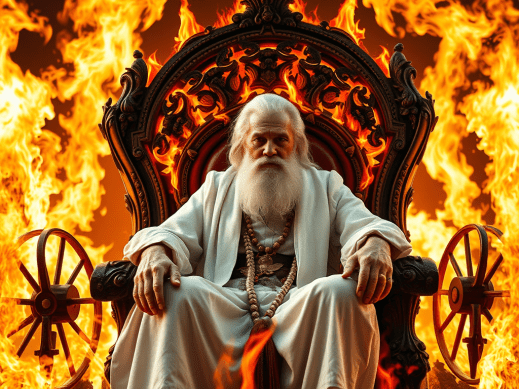
In the King James Version of the Bible, “the Lord Jesus or the Lord Jesus Christ” is mentioned 58 times. In the American Standard Version it is only mentioned 50 times. Darby, 53 times and in the Douay-Rheims, 50 times. According to the D-R & the ASV, the first usage is Mark 16:19. The KJV & Darby, Luke 24:3. According to the NA-27 Text, the D-R and the ASV are correct. “Jesus” is in the text.
What I want to look at is the word “lord.” Much to my surprise in 22 places the word is not preceded by the article “the.” This means that “lord” should not be capitalized. In every place in the Hebrew Scriptures the article “the” is connected to the word it is used with, like “the LORD God, the LORD of hosts or the Lord God.” This draws a stark contrast with the lord Jesus (Christ) and the LORD God.
For those of you who may not be aware, LORD in all capital letters is always translated Jehovah (Yahweh) = “the existing one.” It is the proper name of the One, True God. There is also the word “Lord,” in lower case letters, which is the word Adonay. Adonay is translated as lord, master or owner.
When it comes to the word Lord or lord in the Christian Scriptures it is the Greek word kurios. Here is the full meaning according to Thayer’s Greek Lexicon:
NT:2962 kurios, kuriou, ho
he to whom a person or thing belongs, about which he has the power of deciding; master, lord
a. used universally, of the possessor and disposer of a thing, the owner Matt 20:8
b. kurios is a title of honor, expressive of respect and reverence, with which servants salute their master, Matt 13:27; 25:20,22; Luke 13:8; 14:22, etc.;
c. this title is given:
a. to God, the ruler of the universe Matt 1:22
b. to the Messiah; and that:
aa. to the Messiah regarded universally: Luke 1:43
bb. to Jesus as the Messiah, Acts 10:36
d. of Christ
(from Thayer’s Greek Lexicon, Electronic Database. Copyright © 2000, 2003, 2006 by Biblesoft, Inc. All rights reserved.)
Jesus Christ is our lord, our master, our savior and even our brother. But what he is not is our king or our God. When you look up “the king Jesus,” there are no matches. Or look up the Lord Jesus God (instead of Christ or Messiah). No matches. Just look up “king,” in the N/T. You will find Jesus as the king of the Jews, the future king of Israel. You will find God called “the King eternal” in 1 Timothy 1:17. Then in Rev. 15:3 we see God called king of the holy ones. And finally in Rev. 14, which is still in the future, we see Jesus being called “Lord of lords and King of kings.”
In summary, Jesus is not the Christian’s king and never will be. He came into existence to be the Jews Messiah, and eventually their King. But, they rejected him as their Messiah and therefore his kingdom has been held in abeyance ever since. Now, his kingdom will not be set up until after the time of Jacob’s Trouble or that which is called “the Day of the LORD.” That “day” will not culminate until after the Battle of Har-Mo’ed (in Hebrew) or Har-Mageddon (in Greek). Then Jesus will set up his kingdom on earth where he will finally be King of the Jews, not king of Christians!
Dan 7:14
And there was given him dominion, and glory, and a kingdom, that all the peoples, nations, and languages should serve him: his dominion is an everlasting dominion, which shall not pass away, and his kingdom that which shall not be destroyed.
ASV
The Most High God, On His Throne, Acc. to Daniel 7
In the King James Version of the Bible, “the Lord Jesus or the Lord Jesus Christ” is mentioned 58 times. In the American Standard Version it is only mentioned 50 times. Darby, 53 times and in the Douay-Rheims, 50 times. According to the D-R & the ASV, the first usage is Mark 16:19. The KJV & Darby, Luke 24:3. According to the NA-27 Text, the D-R and the ASV are correct. “Jesus” is in the text.
What I want to look at is the word “lord.” Much to my surprise in 22 places the word is not preceded by the article “the.” This means that “lord” should not be capitalized. In every place in the Hebrew Scriptures the article “the” is connected to the word it is used with, like “the LORD God, the LORD of hosts or the Lord God.” This draws a stark contrast with the lord Jesus (Christ) and the LORD God.
For those of you who may not be aware, LORD in all capital letters is always translated Jehovah (Yahweh) = “the existing one.” It is the proper name of the One, True God. There is also the word “Lord,” in lower case letters, which is the word Adonay. Adonay is translated as lord, master or owner.
When it comes to the word Lord or lord in the Christian Scriptures it is the Greek word kurios. Here is the full meaning according to Thayer’s Greek Lexicon:
NT:2962 kurios, kuriou, ho
he to whom a person or thing belongs, about which he has the power of deciding; master, lord
a. used universally, of the possessor and disposer of a thing, the owner Matt 20:8
b. kurios is a title of honor, expressive of respect and reverence, with which servants salute their master, Matt 13:27; 25:20,22; Luke 13:8; 14:22, etc.;
c. this title is given:
a. to God, the ruler of the universe Matt 1:22
b. to the Messiah; and that:
aa. to the Messiah regarded universally: Luke 1:43
bb. to Jesus as the Messiah, Acts 10:36
d. of Christ
(from Thayer’s Greek Lexicon, Electronic Database. Copyright © 2000, 2003, 2006 by Biblesoft, Inc. All rights reserved.)
Jesus Christ is our lord, our master, our savior and even our brother. But what he is not is our king or our God. When you look up “the king Jesus,” there are no matches. Or look up the Lord Jesus God (instead of Christ or Messiah). No matches. Just look up “king,” in the N/T. You will find Jesus as the king of the Jews, the future king of Israel. You will find God called “the King eternal” in 1 Timothy 1:17. Then in Rev. 15:3 we see God called king of the holy ones. And finally in Rev. 14, which is still in the future, we see Jesus being called “Lord of lords and King of kings.”
In summary, Jesus is not the Christian’s king and never will be. He came into existence to be the Jews Messiah, and eventually their King. But, they rejected him as their Messiah and therefore his kingdom has been held in abeyance ever since. Now, his kingdom will not be set up until after the time of Jacob’s Trouble or that which is called “the Day of the LORD.” That “day” will not culminate until after the Battle of Har-Mo’ed (in Hebrew) or Har-Mageddon (in Greek). Then Jesus will set up his kingdom on earth where he will finally be King of the Jews, not king of Christians!
Dan 7:14
And there was given him dominion, and glory, and a kingdom, that all the peoples, nations, and languages should serve him: his dominion is an everlasting dominion, which shall not pass away, and his kingdom that which shall not be destroyed.
ASV
The Abominations of Jerusalem by Ezekiel
Lam 5:22 Ezekiel the priest, the son of Buzi
In light of the fact that Israel seems to be wanting to take over the world with the help of the U.S. (by whatever means necessary), I thought these words, from this Hebrew Prophet, would be appropriate at this time.
Ezek 16
Again the word of Yahweh came to me, saying,
2 Son of man, cause Jerusalem to know her abominations;
3 and say, Thus says the Lord Yahweh to Jerusalem: Your birth and your birth is of the land of the Canaanite; the Amorite was your father, and your mother was a Hittite.
4 As for your birth, in the day you were born your navel was not cut, neither were you washed in water to cleanse you; you weren’t salted at all, nor swaddled at all.
5 No eye pitied you, to do any of these things to you, to have compassion on you; but you were cast out in the open field, for that your person was abhorred, in the day that you were born.
6 When I passed by you, and saw you weltering in your blood, I said to you, Though you are in your blood, live; yes, I said to you, Though you are in your blood, live.
7 I caused you to multiply as that which grows in the field, and you increased and grew great, and you attained to excellent ornament; your breasts were fashioned, and your hair was grown; yet you were naked and bare.
8 Now when I passed by you, and looked at you, behold, your time was the time of love; and I spread my skirt over you, and covered your nakedness: yes, I swore to you, and entered into a covenant with you, says the Lord Yahweh, and you became mine.
9 Then washed I you with water; yes, I thoroughly washed away your blood from you, and I anointed you with oil.
10 I clothed you also with embroidered work, and shod you with sealskin, and I girded you about with fine linen, and covered you with silk.
11 I decked you with ornaments, and I put bracelets on your hands, and a chain on your neck.
12 I put a ring on your nose, and earrings in your ears, and a beautiful crown on your head.
13 Thus was you decked with gold and silver; and your clothing was of fine linen, and silk, and embroidered work; you ate fine flour, and honey, and oil; and you were exceeding beautiful, and you did prosper to royal estate.
14 Your renown went forth among the nations for your beauty; for it was perfect, through my majesty which I had put on you, says the Lord Yahweh.
15 But you did trust in your beauty, and played the prostitute because of your renown, and poured out your prostitution on everyone who passed by; his it was.
16 You took of your garments, and made for yourselves high places decked with various colors, and played the prostitute on them: the like things shall not come, neither shall it be so.
17 You also took your beautiful jewels of my gold and of my silver, which I had given you, and made for yourself images of men, and played the prostitute with them;
18 and you took your embroidered garments, and covered them, and did set my oil and my incense before them.
19 My bread also which I gave you, fine flour, and oil, and honey, with which I fed you, you did even set it before them for a sweet savor; and thus it was, says the Lord Yahweh.
20 Moreover you have taken your sons and your daughters, whom you have borne to me, and these have you sacrificed to them to be devoured. Were your prostitution a small matter,
21 that you have slain my children, and delivered them up, in causing them to pass through the fire to them?
22 In all your abominations and your prostitution you have not remembered the days of your youth, when you were naked and bare, and was weltering in your blood.
23 It is happen after all your wickedness, (woe, woe to you! says the Lord Yahweh),
24 that you have built to you a vaulted place, and have made you a lofty place in every street.
25 You have built your lofty place at the head of every way, and have made your beauty an abomination, and have opened your feet to everyone who passed by, and multiplied your prostitution.
26 You have also committed sexual immorality with the Egyptians, your neighbors, great of flesh; and have multiplied your prostitution, to provoke me to anger.
27 See therefore, I have stretched out my hand over you, and have diminished your ordinary food, and delivered you to the will of those who hate you, the daughters of the Philistines (Palestine), who are ashamed of your lewd way.
28 You have played the prostitute also with the Assyrians, because you were insatiable; yes, you have played the prostitute with them, and yet you weren’t satisfied.
29 You have moreover multiplied your prostitution to the land of merchants, to Chaldea; and yet you weren’t satisfied with this.
30 How weak is your heart, says the Lord Yahweh, seeing you do all these things, the work of an impudent prostitute;
31 in that you build your vaulted place at the head of every way, and make your lofty place in every street, and have not been as a prostitute, in that you scorn pay.
32 A wife who commits adultery! who takes strangers instead of her husband!
33 They give gifts to all prostitutes; but you give your gifts to all your lovers, and bribe them, that they may come to you on every side for your prostitution.
34 You are different from other women in your prostitution, in that none follows you to play the prostitute; and whereas you give hire, and no hire is given to you, therefore you are different.
35 Therefore, prostitute, hear the word of Yahweh:
36 Thus says the Lord Yahweh, Because your filthiness was poured out, and your nakedness uncovered through your prostitution with your lovers; and because of all the idols of your abominations, and for the blood of your children, that you gave to them;
37 therefore see, I will gather all your lovers, with whom you have taken pleasure, and all those who you have loved, with all those who you have hated; I will even gather them against you on every side, and will uncover your nakedness to them, that they may see all your nakedness.
38 I will judge you, as women who break wedlock and shed blood are judged; and I will bring on you the blood of wrath and jealousy.
39 I will also give you into their hand, and they shall throw down your vaulted place, and break down your lofty places; and they shall strip you of your clothes, and take your beautiful jewels; and they shall leave you naked and bare.
40 They shall also bring up a company against you, and they shall stone you with stones, and thrust you through with their swords.
41 They shall burn your houses with fire, and execute judgments on you in the sight of many women; and I will cause you to cease from playing the prostitute, and you shall also give no hire any more.
42 So will I cause my wrath toward you to rest, and my jealousy shall depart from you, and I will be quiet, and will be no more angry.
43 Because you have not remembered the days of your youth, but have raged against me in all these things; therefore, behold, I also will bring your way on your head, says the Lord Yahweh: and you shall not commit this lewdness with all your abominations.
44 Behold, everyone who uses proverbs shall use this proverb against you, saying, As is the mother, so is her daughter.
45 You are the daughter of your mother, who loathes her husband and her children; and you are the sister of your sisters, who loathed their husbands and their children: your mother was a Hittite, and your father an Amorite.
46 Your elder sister is Samaria, who dwells at your left hand, she and her daughters; and your younger sister, who dwells at your right hand, is Sodom and her daughters.
47 Yet have you not walked in their ways, nor done after their abominations; but, as if that were a very little thing, you were more corrupt than they in all your ways.
48 As I live, says the Lord Yahweh, Sodom your sister has not done, she nor her daughters, as you have done, you and your daughters.
49 Behold, this was the iniquity of your sister Sodom: pride, fullness of bread, and prosperous ease was in her and in her daughters; neither did she strengthen the hand of the poor and needy.
50 They were haughty, and committed abomination before me: therefore I took them away as I saw good.
51 Neither has Samaria committed half of your sins; but you have multiplied your abominations more than they, and have justified your sisters by all your abominations which you have done.
52 You also, bear you your own shame, in that you have given judgment for your sisters; through your sins that you have committed more abominable than they, they are more righteous that you: yes, be also confounded, and bear your shame, in that you have justified your sisters.
53 I will turn again their captivity, the captivity of Sodom and her daughters, and the captivity of Samaria and her daughters, and the captivity of your captives in the midst of them;
54 that you may bear your own shame, and may be ashamed because of all that you have done, in that you are a comfort to them.
55 Your sisters, Sodom and her daughters, shall return to their former estate; and Samaria and her daughters shall return to their former estate; and you and your daughters shall return to your former estate.
56 For your sister Sodom was not mentioned by your mouth in the day of your pride,
57 before your wickedness was uncovered, as at the time of the reproach of the daughters of Syria, and of all who are round about her, the daughters of the Philistines, who do despite to you round about.
58 You have borne your lewdness and your abominations, says Yahweh.
59 For thus says the Lord Yahweh: I will also deal with you as you have done, who have despised the oath in breaking the covenant.
60 Nevertheless I will remember my covenant with you in the days of your youth, and I will establish to you an everlasting covenant.
61 Then shall you remember your ways, and be ashamed, when you shall receive your sisters, your elder sisters and your younger; and I will give them to you for daughters, but not by your covenant.
62 I will establish my covenant with you; and you shall know that I am Yahweh; (When? After the Rapture and the Battle of Har-Mo’ed).
63 that you may remember, and be confounded, and never open your mouth any more, because of your shame, when I have forgiven you all that you have done, says the Lord Yahweh.
WEB
Sons of God
Following up on last night’s teaching:
(10/27/25, https://www.youtube.com/@doctrineandpractice7337) and the clarification I sought on becoming angels, I decided to look up “sons of God.” The KJV lists 6 usages in the CS, (Christian Scriptures). Upon looking at them, four were 5043 and two were 5207, teknon and huios, respectively. Since “inquiring minds” want to know, I decided to look “sons of God” in Darby in the CS and there are only 4; 2 of the same and 2 different ones. The 2 same are Ro 8:14,19. The 2 different ones are Mt 5:9 and Lk 20:36.
Then I looked up huios in the Englishman’s and it coincided with the 4 usages of SoG in Darby. I found the Luke usage particularly interesting.
Luke 20:34-36 And Jesus said to them, The sons of this world marry and are given in marriage, but they who are counted worthy to have part in that world, and the resurrection from among [the] dead, neither marry nor are given in marriage; for neither can they die any more, for they are equal to angels, and are sons of God, being sons of the resurrection.
Darby
This verse is the “clincher:”
Luke 20:36
36 for neither can they die any more, for they are equal to angels, and are sons of God, being sons of the resurrection. Darby
In there we have the word “counted worthy.” Are we not already counted worthy in Christ?
“…they who shall be accounted worthy, NT:2661
kataxioo (kat-ax-ee-o’-o); from NT:2596 and NT:515; to deem entirely deserving:
This word is only used 3X, here, Acts 5:41 and 2Thess. 1:5
Acts 5:40-42
40 And they listened to his advice; and having called the apostles, they beat them and enjoined them not to speak in the name of Jesus and dismissed them.
41 They therefore went their way from [the] presence of the council, rejoicing that they were counted worthy to be dishonoured for the name.
42 And every day, in the temple and in the houses, they ceased not teaching and announcing the glad tidings that Jesus [was] the Christ. Darby
2 Thess 1:4-7
4 so that we ourselves make our boast in you in the assemblies of God for your endurance and faith in all your persecutions and tribulations, which ye are sustaining;
5 a manifest token of the righteous judgment of God, to the end that ye should be counted worthy of the kingdom of God, for the sake of which ye also suffer;
6 if at least [it is a] righteous thing with God to render tribulation to those that trouble you,
7 and to you that are troubled repose with us, at the revelation of the Lord Jesus from heaven, with [the] angels of his power, Darby
IN VERSE 5 ABOVE “should be” kinda stuck in my craw! Here it is in the NAU
This is a plain indication of God’s righteous judgment so that you will be considered worthy of the kingdom of God, for which indeed you are suffering. (2Th 1:5 NAU)
Whether it is will be, may be or should be, it is still the same single word, kataxioo, which means to deem entirely deserving or judge worthy. I think there is no doubt we will sons of God, equal to angels.
(The following is Robert B. Wassung’s addition):
Next, there are a couple (OK, five) in the Hebrew Scriptures that back up the idea that “sons of God” were angelic (and will be angelic). The two (2) in Genesis 6 where we can see quite obviously that they came to the planet of their own volition (reading 2 Peter 2:4 (ye olde “angels that sinned”) and Jude 6 (“angels that did not keep their own principality”)). They were angelic beings, these “sons”. This is backed up by the LXX rendering of the Hebrew “sons of God” in Job 1:6 and 2:1 with “angels of God”. So, also, that other verse in Job 38:7 where the LXX also changes “sons of God” to “angels of God”. The Septuagint is sometimes paraphrastic and sometimes as a different substrate. Either way you see what they saw…”sons of God” were angelic.
One other thing that finally made sense after all these years of wrong teaching was that believing Israel will also, in the resurrection, be “sons of God” and “are equal to the angels” as Fred has shown. They also get new bodies in the resurrection to the earth (first resurrection). They won’t die because they already died once (Revelation 20:6). Second death has no authority over them.
This should not be used to try to prove that angels cannot die, just that these who were resurrected cannot die again. We know angels die (Psalm 82, those in Genesis 6 who became men and died after 120 years). The Dragon will die and get sent to Sheol (Isaiah 14 and Revelation 20). Some are in Sheol until the “judgment of the great day”. If you’re in Sheol, whether humans sleeping or Rephaim walking around…you’re dead. But when all of us believers will be “born again”/”born from above”/ “born of God” we will make Creation happy since it’s been waiting a while to “see” them.
The idea that I mentioned (casually) that Christians replace the “sons of God” who initially had dominion over the nations, is built up from these references Fred has given and a few other logical thoughts (we’re going to be “fellow-kings with him” and Jesus (and us) will have “put down all rule and all authority and power. (1 Cor. 15:24). We always say that once we are in heaven via the Rapture, we’ll come back with him (1 Thessalonians 3:13) and “all the holy ones”.
I just found an interesting podcast (part way through it…) with a guy named David Burnett:
Replacing the Sons of God & New Celestial Bodies According to the Apostle Paul ft. David Burnett
In it he proposes that the list of earthly and heavenly creatures in 1 Corinthians 15:39-42 follows the same order of creatures as enumerated in the context of Deuteronomy 4:15-19. There Moses has said that the celestial beings (son, moon and stars…the heavenly host) that can be worshipped…should not be worshipped, duh. But the interesting thing there (and elsewhere in Deuteronomy) is that these celestial beings were “those which the LORD your God has allotted to all the peoples under the whole heaven” (Deut. 4:19 NAU). This bespeaks the idea that at Babel, God decided he was done with the “nations” and gave their governance to his “sons” (cf. – Deuteronomy 32:8 (read with the Dead Sea Scrolls and the LXX) with the Babel context). Of course, we know He wanted (and built) Israel from two people.
Anyway, there’s probably more stuff that shows that we Christians, as fellow-kings with Jesus are taking over their tasks in the Eschaton.
Why ‘Church’ Should Be Replaced by ‘Assembly’
When a friend of mine first introduced the idea of Jesus building his Church in heaven and not on the earth, and then highlighted that the church here should be called the Church of God according to the Christian Scriptures, it motivated me to look for that scripture that we all know so well, ”the Lord added to the Church daily….”
Here we have it in the beloved KJV that most of us grew up on:
Acts 2:47
Praising God and having favour with all the people. And the Lord added to the church daily such as should be saved. KJV
If Jesus’s Church is in Heaven, how could he be adding to it daily here on earth? (This deserves a pause for answers). Could the answer be just a matter of Translation? Let’s see what two other translations say:
Acts 2:47
praising God and having favor with all the people. And the Lord was adding to their number day by day those who were being saved. NASU
Acts 2:47
praising God, and having favour with all the people; and the Lord added [to the assembly] daily those that were to be saved.
Darby
Now that we have found a conflict between the 3 translations, what do we do? If we have a Greek Interlinear, we go look to see what it says. It says <church> 846 auto, the same, as in all the people. So, ekklesia, which we all have been taught means church, does not exist in Acts 2:47. (The sideways carrot marks < > generally indicated that what is between them is not in the texts, as is the case here). This comes as quite a surprise to me.
To me this posed quite a quandary! Where do I go from here? Another formerly held belief shattered to smitherenes! So what’s left to do, look up ekklesia. Here is what it means according to Thayer’s Greek Lexicon:
“a gathering of citizens called out from their homes into some public place; an assembly.” (See side column for further definition). What we don’t see, is the word ”church,” as any part of the definition. What we do see, predominantly, is ”Assembly.”
Etymology of the word Church
“The etymology of the word “church” is a complex and multifaceted topic. Based on the provided search results, here is a summary of the key findings: Greek origins:
The English word “church” is ultimately derived from the Greek adjective “kuriakos” (κυριακός), meaning “of (or belonging to) the Lord”.
This adjective is found only twice in the Christian Scriptures, in 1 Corinthians 11:20 and Revelation 1:10, referring to the Lord’s supper and the Lord’s day, respectively.”
1 Cor 11:20
Therefore, when you meet together, it is not to eat the Lord’s Supper.
The Lord’s is the word kuriakos (koo-ree-ak-os’) NT:2960; from NT:2962, kurios; belonging to the Lord (Jehovah or Jesus):
Rev 1:10-11
I was in the spirit on the Lord’s day, and I heard behind me a loud voice like the sound of a trumpet, NASU
Now we will look at Young’s Literal Translation of a few verses containing ekklesia:
Matt 16:18
‘And I also say to thee, that thou art a rock, and upon this rock I will build my assembly, and gates of Hades shall not prevail against it;
Acts 5:11
11 and great fear came upon all the assembly, and upon all who heard these things.
Eph 1:22-23
22 and all things He did put under his feet, and did give him — head over all things to the assembly,
23 which is his body, the fulness of Him who is filling the all in all,
Not in one verse, of 114 scriptures, where ekklesia is used, does the YLT translate it Church!
Much like we have eliminated Old Testament and New Testament from our vocabulary, I think it is time to eliminate “Church” as well! If as close as we can come to it, is a transliteration of kuriakos, we have a pretty weak case for using it at all.
I am of the opinion that what exists in the Hebrew Scriptures should set the precedence for the Christian Scriptures. For example, Church doesn’t exist in the Hebrew Scriptures any more than resurrection does. But what does exist is qahal — OT:6951 an assembly, a company, a congregation, a convocation
a) an assembly for evil counsel, for war or invasion, for religious purposes Ex. 12:6
b) a company (used of returning exiles) Ez. 38:15
c) a congregation as an organized body Joel 2:16
(from The Online Bible Thayer’s Greek Lexicon and Brown Driver & Briggs Hebrew Lexicon, Copyright © 1993, Woodside Bible Fellowship, Ontario, Canada. Licensed from the Institute for Creation Research.)
Deut 31:30 Then Moses spoke in the hearing of all the assembly of Israel the words of this song, until they were complete: NASU
Judg 20:2 And the chief of all the people, even of all the tribes of Israel, presented themselves in the assembly of the people of God, four hundred thousand footmen that drew sword. KJV
Qahal is used 123 times in the Hebrew Scriptures, coming close to the 114 of ekklesia!
Other usages of Assembly in the Hebrew Scriptures:
5712, edah, 149 times
6116, atsarah, 11 times
5475, cowd, 21 times Job 15:8, 29:4 the secret of God; Ps. 89:7 the assembly of the saints!
4186, mowshab, 44 times
4150, mowed/moed, 223 times Is. 41:13 Mount of Assembly
When it comes to the phrase, “Church of God,” it is used 8 times in the Christian Scriptures. All 8 of these verses use the word ekklesia, which we now know does not mean “church!” 6 words in the Hebrew Scriptures are translated “assembly” many times in their 571 usages; never church. Therefore, in my humble opinion, Assembly should replace the word church everywhere it is used in the Christian Scriptures, just like the Young’s Literal Translation has! Since we no longer say the word mystery for musterion, neither should we say the word church, for ekklesia.
Identifying the False Prophet; the Predecessor of the Antichrist
One of the keys to understanding who is what in the book of Revelation being able to see the different Greek words from which our English words are translated. Beast for example is translated from either zoon or therion:
NT:2226 zoon (dzo’-on); neuter of a derivative of NT:2198; a live thing, i.e. an animal: KJV – beast. NT:2198 zao (dzah’-o); a primary verb; to live (literally or figuratively).
NT:2342 therion (thay-ree’-on); diminutive from the same as NT:2339; a dangerous animal: KJV – (venomous, wild) beast. NT:2339 thera (thay’-rah); from ther (a wild animal, as game); hunting, i.e. (figuratively) destruction: KJV – trap.
Zoon is used 7 times and therion is used 37 times in Revelation. Here we can see that therion is not just any living animal, but a wild, dangerous and destructive one as well.
Rev 13:11-17 describes this Beast from the Earth
11 Then I saw another beast (therion) coming up out of the earth; and he had (having) two horns like a lamb and he spoke as a dragon. 12 He exercises all the authority of the first beast (therion) in his presence. And he makes the earth and those who dwell in it to worship the first beast (therion), whose fatal wound was healed. 13 He performs great signs, so that he even makes fire come down out of heaven to the earth in the presence of men. 14 And he deceives those who dwell on the earth because of the signs which it was given him to perform in the presence of the beast (therion), telling those who dwell on the earth to make an image to the beast (therion) who had the wound of the sword and has come to life. 15 And it was given to him to give breath to the image of the beast (therion), so that the image of the beast (therion) would even speak and cause as many as do not worship the image of the beast (therion) to be killed. 16 And he causes all, the small and the great, and the rich and the poor, and the free men and the slaves, to be given a mark on their right hand or on their forehead, 17 and he provides that no one will be able to buy or to sell, except the one who has the mark, either the name of the beast (therion) or the number of his name. NASU
Rev 16:13
And I saw (coming) out of the mouth of the dragon, and out of the mouth of the beast, and out of the mouth of the false prophet, three unclean spirits, as it were frogs: ASV
He is mentioned again in Rev 19:20
And the beast was taken, and with him the false prophet that wrought miracles before him, with which he deceived them that had received the mark of the beast, and them that worshipped his image. KJV
And, finally after the Millennial Kingdom:
Rev 20:10
And the devil who deceived them was thrown into the lake of fire and brimstone, where the beast and the false prophet are also; and they will be tormented day and night forever and ever. NASB
Now let us look at 12 attributes of this 2nd therion beast:
- Comes from the earth as opposed to the 1st beast who comes from the sea;
- Has 2 horns
- Speaks eloquently “as a”(figure of speech simile) dragon- NT:1404 drakoon, drakontos, ho a great serpent, a fabulous animal
- Exercises all the authority (exousia, physical and mental power, influence, rights, governance) of the 1st beast
- Makes the earth and those who dwell in it to worship the first beast
- Causes great signs (miracles and wonders),
- Makes fire come down out of heaven to the earth in the presence of men
- Deceives those who dwell on the earth because of the signs
- Tells, commands, those who dwell on the earth to make an image to the beast
- And it was given to him (autos, he, she or it), to give breath (pneuma, spirit) to the image (eikoon, likeness, figure) of the beast
- Causes as many as do not worship the image of the beast (therion) to be killed
- Causes all, to be given a mark (charagma, an etching, stamp or sculpted figure) on their right hand or on their forehead, so that no one will be able to buy or to sell, except the one who has the mark, either the name of the beast (therion) or the number of his name
The Comforter has Come, the Comforter has Come, or has It/He?
To get an understanding of who or what the Comforter/Helper is let’s look at everything the scriptures say about it:
John 14:15-21, 25-26
15 If ye love me, keep my commandments. 16 And I will pray the Father, and he shall give you another Comforter, that he (it) may abide with you for ever; 17 Even the spirit of truth; whom the world cannot receive, because it seeth him not, neither knoweth him: but ye know him; for he dwelleth with you, and shall be (in the future) in you. 18 I will not leave you comfortless: I will come to you. 19 Yet a little while, and the world seeth me no more; but ye see me: because I live, ye shall live also.
20 At that day* (the day of the LORD) ye shall know that I am in my Father, and ye in me, and I in you.
21 He that hath my commandments, and keepeth them, he it is that loveth me: and he that loveth me shall be loved of my Father, and I will love him, and will manifest myself to him. 25 These things have I spoken unto you, being yet present with you. 26 But the Comforter, which is the Holy Ghost, whom the Father will send in my name, he/it shall teach you all things, and bring all things to your remembrance, whatsoever I have said unto you. (Whatsoever he said to them)!
KJV
* The first usage of “that day” in the “New Testament” is Matt 7:22
Many will say to me in that day, Lord, Lord, have we not prophesied in thy name? and in thy name have cast out devils? and in thy name done many wonderful works? KJV
* the 2nd usage is Matt 24:36
But of that day and hour knoweth no man, no, not the angels of heaven, but my Father only. KJV
See also Mt 26:29, Mk 13:32, Lk 6:23, 17:31, Jn 16:23,26.
John 16:7-15
“But I tell you the truth, it is to your advantage that I go away; for if I do not go away, the helper shall not come to you; but if I go, I will send it to you. 8 “And when it comes will convict the world concerning sin, righteousness, and judgment; 9 concerning sin, because they do not believe in me; and concerning righteousness, because I go to the Father, and you no longer behold me; 11 and concerning judgment, because the ruler of this world has been judged. 12 “I have many more things to say to you, but you cannot bear them now. 13 “But when it, the spirit of truth, comes, it will guide you into all the truth; for it will not speak on its own initiative, but whatever it hears, it will speak; and it will disclose to you what is to come. 14 “It shall glorify me; for it shall take of mine, and shall disclose it to you. 15 “All things that the Father has are mine; therefore I said, that it takes of mine, and will disclose it to you.
FSW
John 15:26-27
“When the helper comes, whom I will send to you from the Father, that is the spirit of truth, who proceeds from the Father, it will bear witness of me, 27 and you will bear witness also, because you have been with me from the beginning. FSW
Here are most of the things that this thing is going to do when it comes:
- It shall teach you all things(not some)
- It shall bring all things to your remembrance, whatever Jesus has said to you.
- It will reprove the world of sin.
- It will reprove the world of righteousness
- It will reprove the world of judgment
- It will guide you into all truth (not some)
- It will show you things to come.
I can’t speak for anyone else, but the spirit I received when I made Jesus my Lord and spoke in tongues hasn’t done allof these things! In light of the fact that Jesus did not know about the Secret, which God kept hidden from all the Hebrew prophets, this Comforter was designed to do the above things for Jesus’s Flock until he returned.
THE ASSEMBLY OF GOD
| When a friend of mine first introduced the idea of Jesus building his Church in heaven and not on the earth, and then highlighted that the church here should be called the Church of God according to the Christian Scriptures, it motivated me to look for that scripture that we all know so well, ”the Lord added to the Church daily….” Here we have it in the beloved KJV that most of us grew up on: Acts 2:47 Praising God, and having favour with all the people. And the Lord added to the church daily such as should be saved. KJV If Jesus’s Church is in Heaven, how could he be adding to it daily here on earth? (This deserves a pause for answers). Could the answer be just a matter of Translation? Let’s see what a more accurate translation says: Acts 2:47 praising God and having favor with all the people. And the Lord was adding to their number day by day those who were being saved. NASU Now that we have found a conflict between the 2 translations, what do we do? If we have a Greek Interlinear, we go look to see what it says. It says <church> 846 (Strong’s Number) auto, the same, as in all the people. So, ekklesia, 1577, which we all have been taught means church, does not exist in Acts 2:47. (The sideways carrot marks < > generally indicated that what is between them is not in the texts, as is the case here). To me this posed quite a quandary! Where do I go from here? Another formerly held belief shattered to smitherenes! So what’s left to do, look up ekklesia. Here is what it means according to Thayer’s Greek Lexicon: “a gathering of citizens called out from their homes into some public place; an assembly.” What we don’t see, is the word ”church,” as any part of the definition. What we do see, predominantly, is ”Assembly.” Now we will look at Young’s Literal Translation of a few verses containing ekklesia: Matt 16:18 ‘And I also say to thee, that thou art a rock, and upon this rock I will build my assembly, and gates of Hades shall not prevail against it; Acts 5:11 11 and great fear came upon all the assembly, and upon all who heard these things. Eph 1:22-23 22 and all things He did put under his feet, and did give him — head over all things to the assembly, 23 which is his body, the fulness of Him who is filling the all in all, Not in one verse of 114 scriptures where ekklesia is used, does the YLT translate it Church! You might be asking yourself, ”If ekklesia doesn’t mean Church, then what the heck, if anything, does?” Good question. Etymology of the word Church The etymology of the word “church” is a complex and multifaceted topic. Based on the provided search results, here is a summary of the key findings: Greek origins: The English word “church” is ultimately derived from the Greek adjective “kuriakos” (κυριακός), meaning “of (or belonging to) the Lord”. This adjective is found only twice in the New Testament, in 1 Corinthians 11:20 and Revelation 1:10, referring to the Lord’s supper and the Lord’s day, respectively. |
| 1 Cor 11:20 Therefore when you meet together, it is not to eat the Lord’s Supper, The Lord’s is the word NT:2960 kuriakos (koo-ree-ak-os’); from NT:2962, kurios; belonging to the Lord (Jehovah or Jesus): (Biblesoft’s New Exhaustive Strong’s Numbers and Concordance with Expanded Greek-Hebrew Dictionary. Copyright © 1994, 2003, 2006 Biblesoft, Inc. and International Bible Translators, Inc.) Rev 1:10-11 I was in the spirit on the Lord’s day, and I heard behind me a loud voice like the sound of a trumpet, NASU Much like we have eliminated Old Testament and New Testament from our vocabulary, I think it is time to eliminate “Church” as well! If as close as we can come to it, is a transliteration of kuriakos, we have a pretty weak case for using it at all. |
Transliteration vs. Translation:
The word “church” is a transliteration of the Greek “kuriakos,” rather than a translation of its meaning into English. This means that the word “church” does not accurately convey the original Greek concept.
Substitution for ekklēsia: In English translations of the New Testament, the word “church” substitutes for the Greek noun “ekklēsia” (ἐκκλησία), which occurs 114 times in the Greek New Testament. This substitution obscures the original meaning of “ekklēsia”, which refers to the gathering or assembly of believers.
Alternative etymologies:
Some sources propose alternative etymologies for the word “church”, including:
Connection to the name “Circe”, a sorceress-goddess from Greek mythology, which is unlikely and lacks historical evidence.
Derivation from the Old English “circe” or “cyrc”, which is related to the Dutch “kerk” and German “Kirche”, ultimately tracing back to the Greek phrase “kuriakon doma” (Lord’s house).
Architectural significance: The term “church” has also been associated with the architectural design of Christian buildings, particularly in traditional Christian architecture, where the plan view forms a Christian cross.”
I am of the opinion that what exists in the Hebrew Scriptures should set the precedence for the Christian Scriptures. For example, Church doesn’t exist in the Hebrew Scriptures any more than resurrection does. But what does exist is qahal — OT:6951 an assembly, a company, a congregation, a convocation
a) an assembly for evil counsel, for war or invasion, for religious purposes Ex. 12:6
b) a company (used of returning exiles) Ez. 38:15
c) a congregation as an organized body Joel 2:16
(from The Online Bible Thayer’s Greek Lexicon and Brown Driver & Briggs Hebrew Lexicon, Copyright © 1993, Woodside Bible Fellowship, Ontario, Canada. Licensed from the Institute for Creation Research.)
Deut 31:30 Then Moses spoke in the hearing of all the assembly of Israel the words of this song, until they were complete: NASU
Judg 20:2 And the chief of all the people, even of all the tribes of Israel, presented themselves in the assembly of the people of God, four hundred thousand footmen that drew sword. KJV
Qahal is used 123 times in the Hebrew Scriptures, coming close to the 114 of ekklesia!
Other usages of Assembly in the Hebrew Scriptures:
5712, edah, 149 times
6116, atsarah, 11 times
5475, cowd, 21 times Job 15:8, 29:4 the secret of God; Ps. 89:7 the assembly of the saints!
4186, mowshab, 44 times
4150, mowed/moed, 223 times Is. 41:13 Mount of Assembly
1 Cor 10:31-32
Whether, then, ye eat, or drink, or do anything, do all to the glory of God;
32 become offenceless, both to Jews and Greeks, and to the assembly of God;
YLT
I know it’s going to be difficultfor us to stop using the word Church when it comes to a group of believer’s, but you can still call the buildings, churches. Otherwise, the Body of Christ is the Assembly of God.

 Home of the Rightly Divided Word